
Step-by-Step Math Solver vs Calculator: Which One Actually Helps You Pass?
By Imran Al-Ameen Adebayo · Founder of BrainDrill · 3 July 2026 · 5 min read
Search “step by step math calculator” and you'll find dozens of tools that promise the same thing: type in a problem, get an answer. But there's a difference between the tool that gets tonight's homework done and the tool that gets you through the exam hall — and it comes down to one question: does it show the method, or just the result?
What a calculator is for (and what it isn't)
A calculator — scientific, graphing, or an app — is an arithmetic machine. It's brilliant at the part of maths that carries almost no marks: crunching numbers you already know how to set up. What it cannot do is the part exams actually grade — choosing the method, setting up the equation, knowing that this integral wants integration by parts and that circuit wants nodal analysis. Examiners award most of their marks for method: the right formula, the correct substitution, consistent units. A final answer with no working often earns a fraction of the marks even when it's correct.
What “step by step” should really mean
Plenty of tools claim steps. Test any solver against this checklist:
- Every step named, not just shown.“Apply integration by parts with u = x, dv = eˣ dx” teaches you something. Three lines of unexplained algebra doesn't.
- It reads YOUR problem. Typing a problem in is fine; photographing a handwritten equation or a circuit from your past questions is faster and avoids transcription mistakes.
- It checks its own answer. AI tools can be confidently wrong. A solver worth trusting verifies the result — re-deriving it another way or substituting it back — before showing it to you.
- You can ask “why?” A calculator ends at the answer. A tutor lets you push back: why that method? What if the sign flips? What happens to the current if the resistor doubles?
The honest workflow: solver first, calculator second
- Learn the method with a step-by-step solver. Work through one problem until every step makes sense. This is where understanding is built.
- Re-solve it yourself from a blank page.No peeking. If you can't reproduce the method, you haven't learned it yet — repeat step one.
- Use the calculator for arithmetic only. Once the method is yours, the calculator does what it was built for: fast, error-free number crunching inside YOUR working.
- Practise unseen problems under time. The exam tests speed of method recall, not just correctness. Timed practice is the only rehearsal for that.
The trap to avoid
The failure mode isn't using a solver — it's using one passively. If your routine is “photograph the assignment, copy the steps, submit,” you've automated the learning out of your degree, and the exam (where no tool comes with you) will say so. The re-solve-from-blank-page step is what separates studying from outsourcing. Tools don't decide which one you're doing; your next twenty minutes do.
Where BrainDrill fits
Full disclosure: we built BrainDrill to be the first kind of tool. Its AI tutor solves maths, physics, and circuit problems step by step with each step explained, reads photographed problems (snap on your phone, or scan a QR to send the photo straight to your laptop session), verifies its answers by re-deriving them a second, independent way before showing them, and lets you keep asking why until it clicks. Then the quiz side turns your own notes and past questions into timed practice — the blank-page rehearsal that actually converts understanding into marks. The free plan includes real daily tutoring, so you can test the checklist above against it without paying.
Put this into practice with BrainDrill
An AI tutor that shows its work step by step, quizzes generated from your own notes, and live study rooms with friends. Free to start — no card needed.
Try BrainDrill free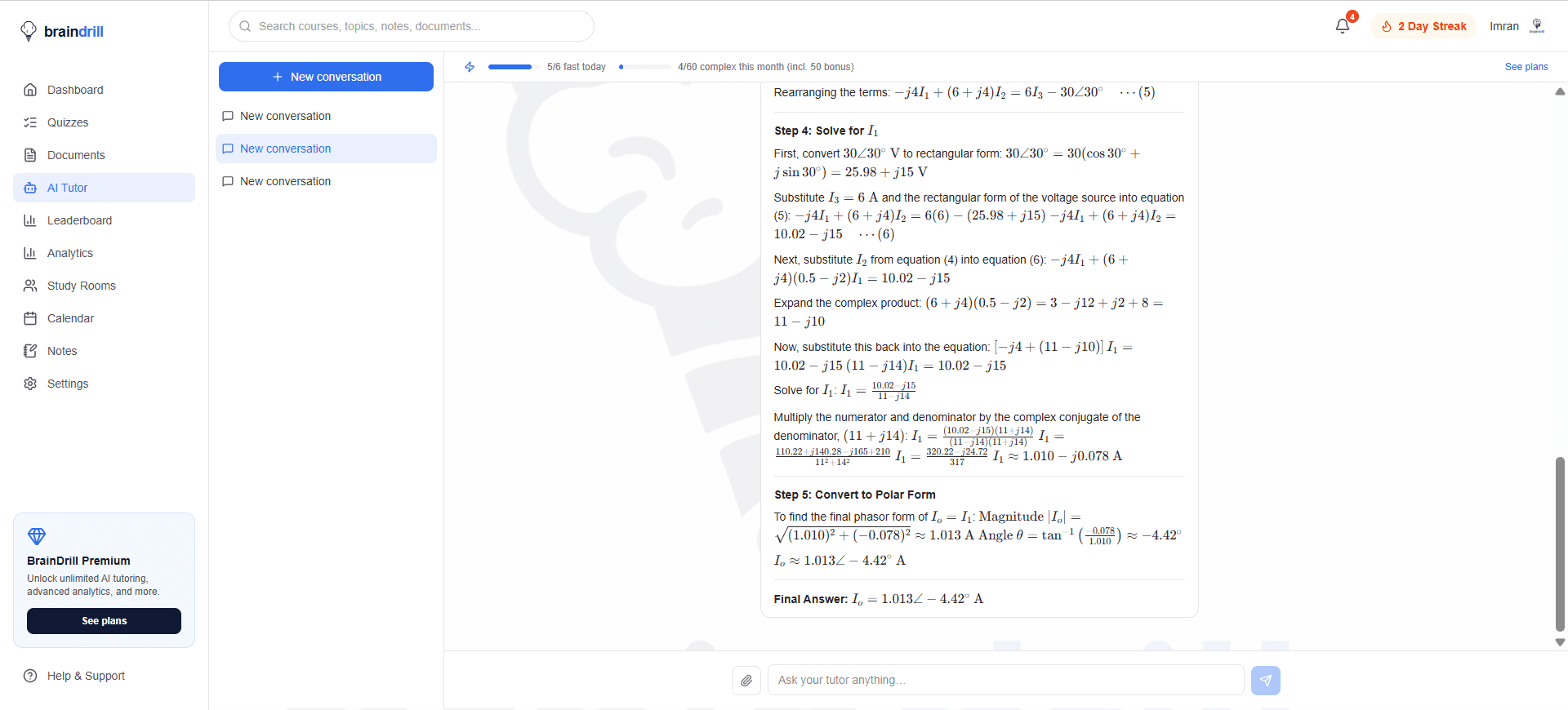
Imran Al-Ameen Adebayo
Engineering student and founder of BrainDrill — building the study app he wished he had. Read his story →
Study smarter, straight to your inbox 📬
One short email a week: a study technique that works, a topic worth drilling, and what's new in BrainDrill. Free, no spam, unsubscribe anytime.