
How to Study Differential Equations: Classify First, Solve Second
By Imran Al-Ameen Adebayo · Founder of BrainDrill · 12 July 2026 · 6 min read
Differential equations has a secret structure: it's a classificationcourse. Nobody solves a DE by staring harder — they identify its type, and the type dictates the method. Students who train identification explicitly find the course almost formulaic; students who don't execute beautiful wrong methods.
Build the decision tree before the methods
- First order? Can you separate — ? → separation. Linear in — ? → integrating factor . Exact? → check .
- Second order, constant coefficients? → characteristic equation , three cases by discriminant.
- Nonhomogeneous? → homogeneous solution + particular solution (undetermined coefficients for polynomials/exponentials/sines; variation of parameters when those fail).
- Systems or anything with initial conditions and switches? → Laplace transforms.
Reproduce this tree from memory weekly. On every homework problem, write the classification line first ("linear first-order, integrating factor") — graders love it, and it forces the skill exams actually test.
The three cases everyone mixes up
For : distinct real roots give ; a repeated root gives (the is the part students forget); complex roots give . Write these three on one card and re-derive them once so they're understanding, not incantation.
Integration is the real prerequisite
Every method funnels into an integral, so a shaky by-parts or partial-fractions game turns correct setups into wrong answers. Spend the first week of the course re-drilling Calc 2 integration; it repays itself on literally every problem set.
Applications: one setup, many stories
Springs, RLC circuits, mixing tanks, populations — exams dress the same equations in different costumes. Learn the translation table: damping term ↔ resistor, spring constant ↔ 1/capacitance, forcing function ↔ voltage source. Once you see that and an RLC loop are the same equation, half the applications chapter collapses into things you already know.
The drill plan
- Daily classification sprints: ten cold equations, name the type and method only (no solving) — five minutes that train the exam's real skill.
- Three full solves daily, written to the end, constants evaluated from initial conditions.
- Blank-paper re-solves of every miss, 48 hours later; error log by cause (classification vs integration vs algebra).
- Unstick fast: when a solution's step makes no sense at midnight, get it explained step-by-step immediately — in this course, every method builds on the previous week's.
Frequently asked questions
Why do students fail differential equations?+
Usually not because any single method is hard — separation, integrating factors and characteristic equations are each learnable in an afternoon. Students fail the CLASSIFICATION step: given a cold equation, they reach for the wrong method and execute it perfectly into a wrong answer. Train identification as its own skill.
What calculus do I need to be solid first?+
Integration, honestly and completely: substitution, by parts, partial fractions. A differential equations course is an integration course wearing a trench coat — if your Calc 2 integration is shaky, repair it in week one or every method will wobble.
What's the highest-yield exam topic?+
Second-order linear equations with constant coefficients — the characteristic equation's three cases (distinct real, repeated, complex roots) plus undetermined coefficients for the particular solution. This family anchors every engineering DE exam and most of the applications (springs, circuits).
Put this into practice with BrainDrill
An AI tutor that shows its work step by step, quizzes generated from your own notes, and live study rooms with friends. Free to start — no card needed.
Try BrainDrill free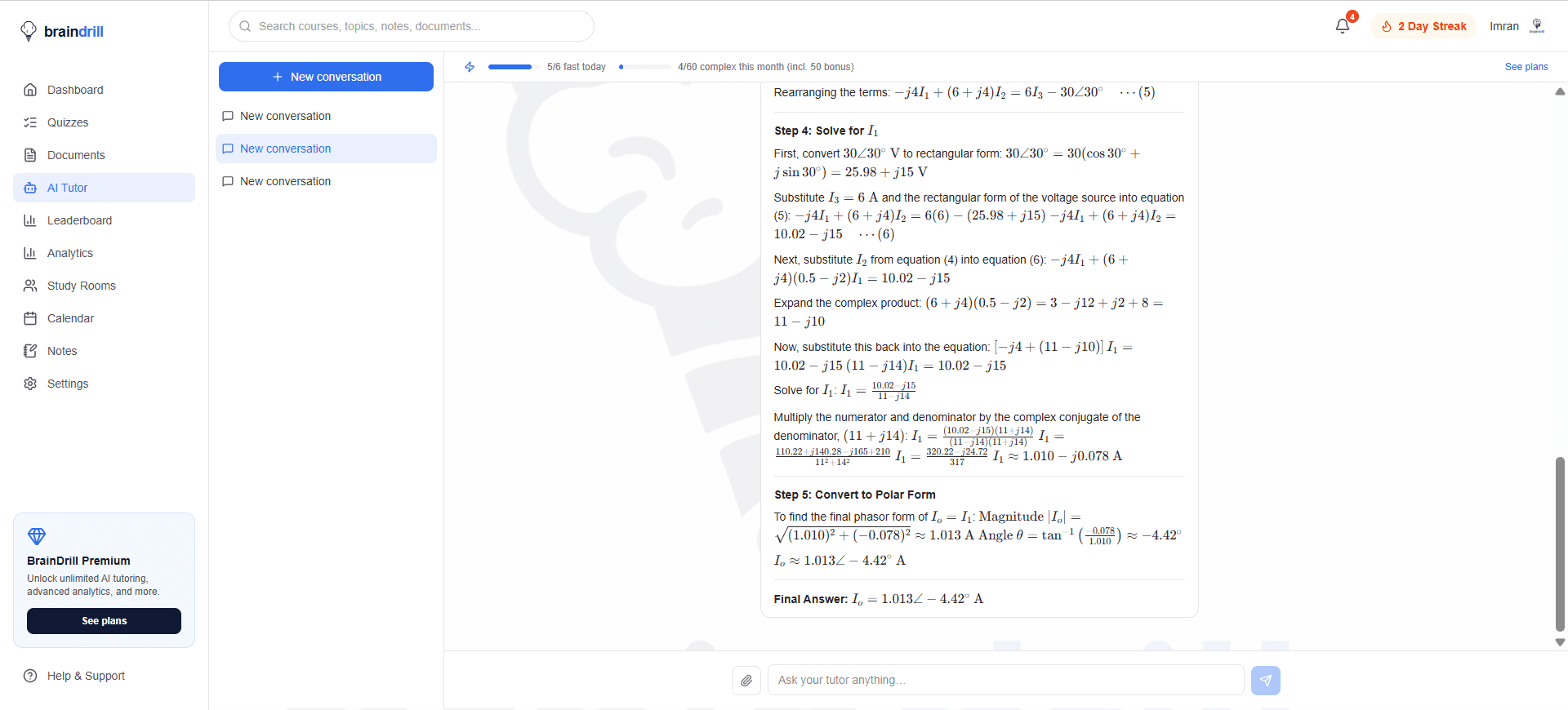
Imran Al-Ameen Adebayo
Engineering student and founder of BrainDrill — building the study app he wished he had. Read his story →
Study smarter, straight to your inbox 📬
One short email a week: a study technique that works, a topic worth drilling, and what's new in BrainDrill. Free, no spam, unsubscribe anytime.