
How to Study Linear Algebra (Without Getting Lost in Abstraction)
By Imran Al-Ameen Adebayo · Founder of BrainDrill · 12 July 2026 · 6 min read
Linear algebra is two courses wearing one name. The first half is friendly computation — solve systems, row-reduce, take determinants. The second half is your first genuinely abstract math course — and it arrives without warning. Studying it well means preparing for the switch before it happens.
The computation layer: make it boring
Row reduction, matrix multiplication, determinants, inverses — these must become mechanical early, because later topics use them as vocabulary. Eigenvalue problems, for instance, are 20% concept and 80% clean determinant-and-solve execution. Drill until a 3×3 row reduction is something your hands do while your brain watches.
The abstraction cliff: definitions are the curriculum
From vector spaces onward, exam questions are disguised definition checks. Make a living document — every definition in your own words, WITH a 2D/3D picture and one example plus one non-example:
- Span — everywhere your arrows can reach; a line/plane through the origin.
- Linear independence — no arrow is redundant; none is built from the others.
- Basis — a minimal spanning crew; dimension is its headcount.
- Null space / column space — what a matrix crushes to zero / everywhere it can land.
- Eigenvector — a direction the transformation only stretches, never turns.
Students who can't state definitions precisely cannot do the proofs — it's that direct.
Connect every concept to Ax = b
The entire course is secretly one question: when does Ax = b have solutions, and how many? Rank, null space, invertibility, determinants, independence of columns — each new tool is another lens on that question. When a topic feels floaty, ask "what does this say about solving systems?" and it usually lands.
A weekly rhythm that survives the semester
- Before lecture: read the definitions only (10 minutes). Lectures make sense when the words are pre-loaded.
- After lecture: redo the lecture's main example from a blank page.
- Weekly: mixed problem set — half computational, half "true/false with justification" (the course's signature exam format).
- Stuck? Get the step explained immediately and then reproduce it solo — in a definitions-stacked course, today's confusion is next week's foundation.
True/false questions: the secret weapon
Working through true/false-with-counterexample banks is the single highest-yield linear algebra practice: each one forces a definition, a theorem's exact hypotheses, or a counterexample. Ten of those daily in the final month is worth more than rereading every chapter twice.
Frequently asked questions
Why does linear algebra suddenly get hard halfway through?+
The course changes character around vector spaces: it stops being about computing (row reduction, determinants) and starts being about definitions and proofs (span, independence, basis, dimension). Students who kept computing without building concepts hit that wall at full speed.
Should I memorise proofs?+
Understand the standard proof patterns rather than memorising word-for-word: 'show it's a subspace' (zero vector, closure twice), 'show independence' (only trivial combination), 'show it's a basis' (spans + independent). Most exam proofs are these three patterns re-costumed.
What's the best way to build intuition?+
Draw everything in 2D/3D first: a span is a line or plane through the origin, independence means no redundant arrows, a determinant is an area/volume scale factor, eigenvectors are the directions a transformation doesn't rotate. Every abstract definition has a picture — find it before the proof.
Put this into practice with BrainDrill
An AI tutor that shows its work step by step, quizzes generated from your own notes, and live study rooms with friends. Free to start — no card needed.
Try BrainDrill free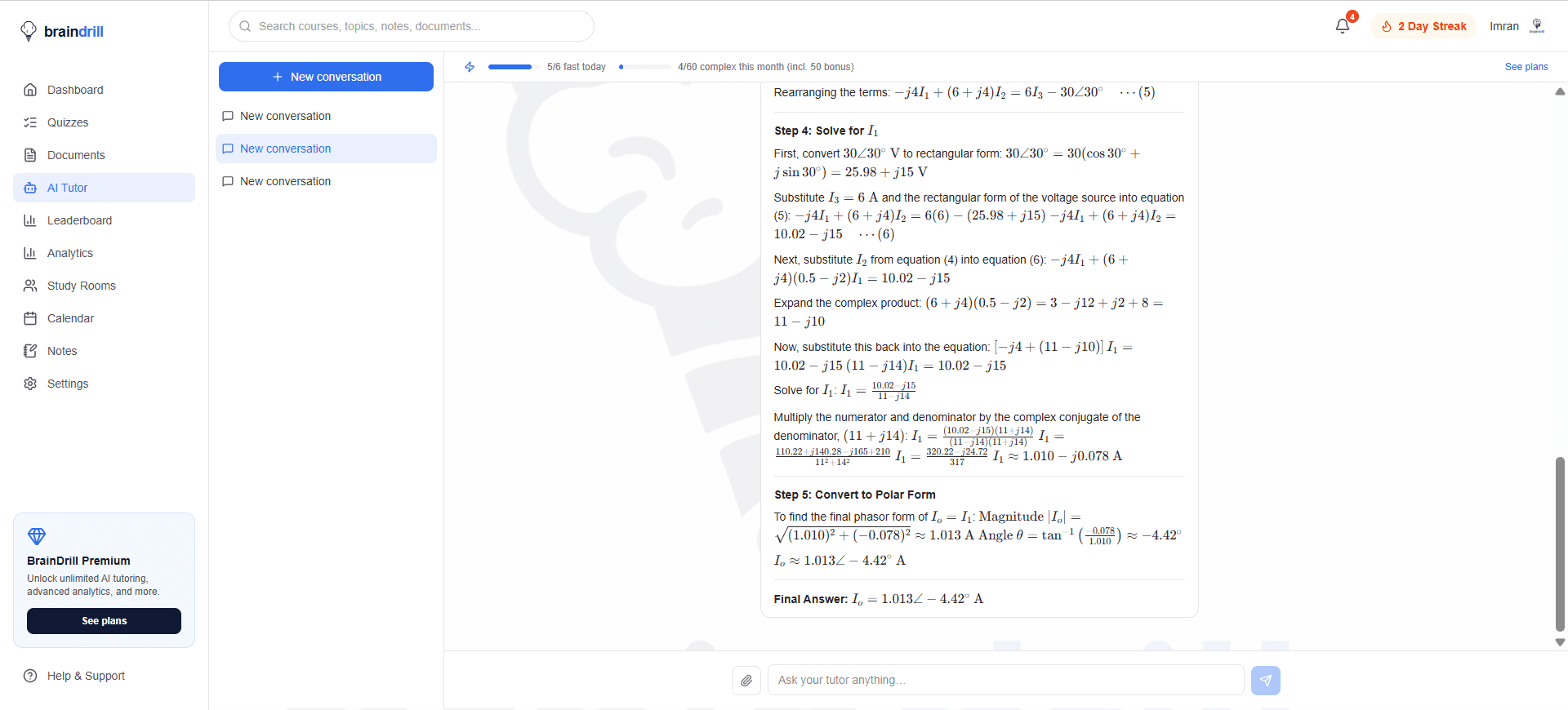
Imran Al-Ameen Adebayo
Engineering student and founder of BrainDrill — building the study app he wished he had. Read his story →
Study smarter, straight to your inbox 📬
One short email a week: a study technique that works, a topic worth drilling, and what's new in BrainDrill. Free, no spam, unsubscribe anytime.