How to Study Circuit Analysis: From KCL to Thévenin
By Imran Al-Ameen Adebayo · Founder of BrainDrill · 12 July 2026 · 7 min read

Circuit analysis is where engineering students discover that "I understood the lecture" and "I can solve the problem" are different universes. The subject is a stack of procedures — and procedures are learned the way pianists learn scales: by running them, badly at first, until they run themselves.
Layer 0: Ohm and the two laws that never leave
Everything reduces to , KCL (currents into a node sum to zero) and KVL (voltages around a loop sum to zero). Before every new chapter, re-earn these on paper: a two-resistor divider, , derived from scratch in under a minute. If a -and- divider takes thought, the advanced methods have nothing to stand on.
Layer 1: nodal and mesh as rituals
- Label first. Reference node, node voltages (or mesh currents), and every polarity — before any equation. Most disasters are labelling disasters.
- Count before choosing. Fewer nodes → nodal; fewer loops → mesh; supernode/supermesh when sources sit awkwardly.
- Write equations mechanically. The moment you're "reasoning" mid-equation instead of transcribing the ritual, you've left the safe path — restart the equation.
- Solve and sanity-check. A 2 A current through a resistor fed by a 5 V source is telling you something went wrong.
Layer 2: Thévenin — the exam's favourite question
Every board loves "find the Thévenin equivalent seen by " because it tests three skills at once: open-circuit voltage , equivalent resistance (kill independent sources — short voltage, open current), and maximum power transfer giving . Drill this family until the three-step dance is automatic; with dependent sources, use the test-source method and expect it on the exam precisely because students avoid it.
Layer 3: AC circuits are DC circuits wearing phasors
The liberating secret of AC analysis: nothing new happens. Replace resistance with impedance — , , — and every DC technique (dividers, nodal, mesh, Thévenin) transfers verbatim with complex arithmetic. Students who struggle with AC are usually struggling with complex numbers, not circuits; a weekend refreshing polar ↔ rectangular conversion pays for the whole semester. The same is true later for Laplace analysis, where transforms make impedances of and .
The drill system
- Three complete problems daily beat twenty on Sunday — procedure skills decay in days.
- Blank-paper rule: any problem you needed help with gets re-solved cold 48 hours later. The help doesn't count until the cold solve succeeds.
- Error log by cause: labelling, convention, equation-count, complex arithmetic, or concept. Each cause has a different cure, and the log tells you which drill you actually need.
- Get unstuck fast. One mysterious sign flip left unresolved poisons every problem after it. An AI tutor that shows the KVL walk step-by-step at 11pm — and then lets you re-run it yourself — is exactly the right medicine.
Exam strategy
Circuit exams reward method marks: a correctly labelled diagram with correct equations earns most of the credit even if the arithmetic slips. So label beautifully, write the governing equation before substituting, and never erase a diagram — redraw next to it. And on multi-part questions, part (a)'s Thévenin equivalent is almost always the machine that makes parts (b) through (d) trivial. Trust the structure.
Frequently asked questions
Why do I understand circuits in lecture but fail the problems?+
Because circuit analysis is a procedure course: watching someone else run nodal analysis feels like understanding, but the skill is choosing and executing the procedure yourself on an unseen network. The gap closes only through solving complete problems from blank paper — typically 100+ across a semester.
Nodal or mesh analysis — which should I use?+
Count the equations each would need: nodal gives one per non-reference node, mesh one per independent loop. Pick whichever is smaller, with two overrides — voltage sources love nodal (supernode), current sources love mesh (supermesh). Deciding this in ten seconds is itself an exam skill worth drilling.
How do I stop sign errors in KVL/KCL?+
Fix a personal convention (passive sign convention: current enters the + terminal) and mark polarities on the diagram BEFORE writing any equation. Sign errors are almost never conceptual — they come from improvising conventions mid-problem.
Put this into practice with BrainDrill
An AI tutor that shows its work step by step, quizzes generated from your own notes, and live study rooms with friends. Free to start — no card needed.
Try BrainDrill free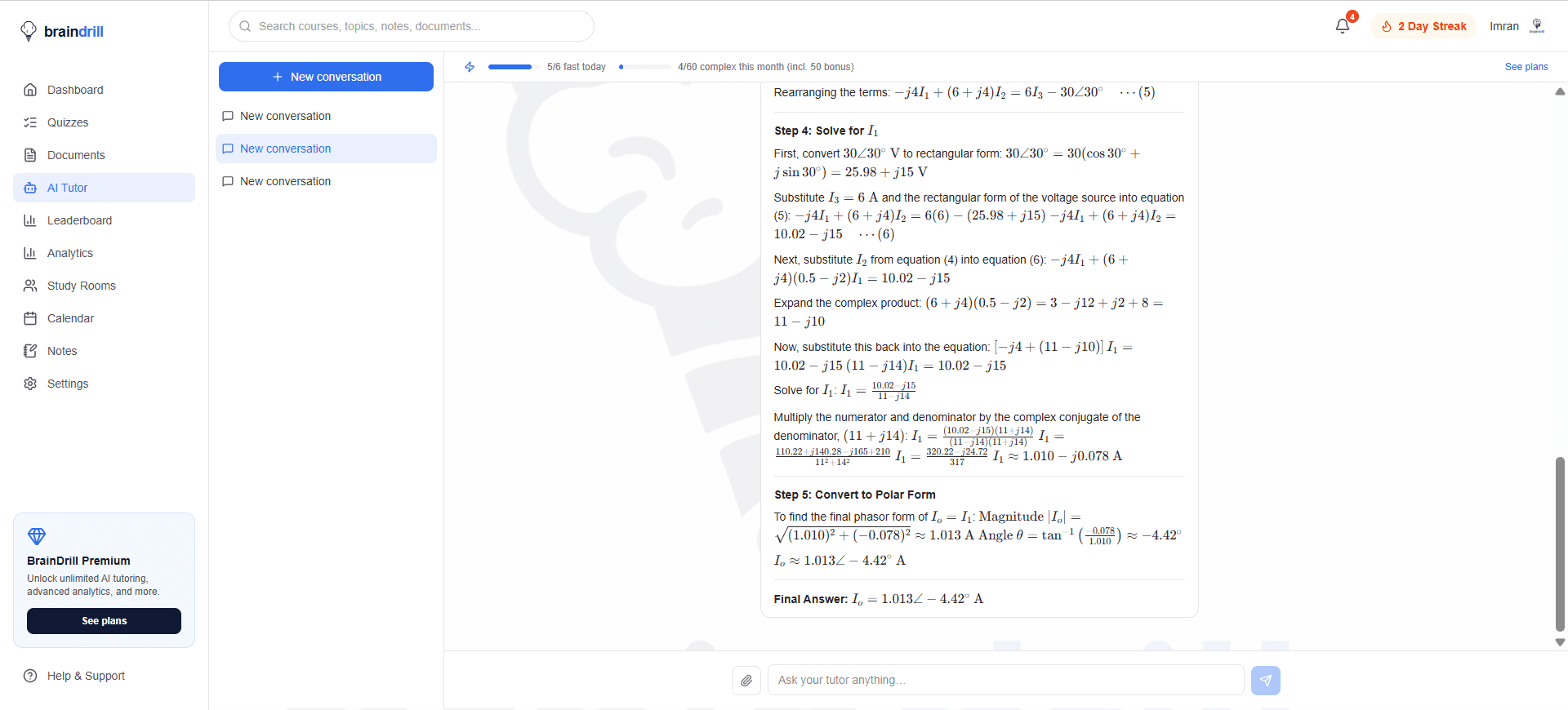
Imran Al-Ameen Adebayo
Engineering student and founder of BrainDrill — building the study app he wished he had. Read his story →
Study smarter, straight to your inbox 📬
One short email a week: a study technique that works, a topic worth drilling, and what's new in BrainDrill. Free, no spam, unsubscribe anytime.