How to Solve Physics Numericals Step by Step (the GRESA Method)
By Imran Al-Ameen Adebayo · Founder of BrainDrill · 3 July 2026 · 6 min read

Physics numericals feel hard for a specific reason: the question hands you a story (“a car accelerates from rest…”) and expects you to turn it into an equation. Students who struggle usually don't lack physics — they lack a procedure for the translation. Here is the one that works, known in many classrooms as GRESA: Given, Required, Equation, Solution, Answer.
The method, step by step
- Given:extract every quantity from the story and write it as a symbol with units. “From rest” means u = 0 m/s. “Uniformly” means constant acceleration. Hidden data lives in the words, not the numbers.
- Required:write the symbol you're solving for. One line. It stops you answering a question that wasn't asked — a shockingly common way to lose full marks with correct physics.
- Equation: pick the relation that connects your Given to your Required — and write it in symbols BEFORE any numbers. Method marks attach to this line.
- Solution: substitute with units attached, and rearrange algebraically before computing where possible.
- Answer: state it with units and a sanity check — is the size physically reasonable?
A worked example
A car starts from rest and accelerates uniformly at 2 m/s² for 5 seconds. Find the distance covered and its final velocity.
Given: u = 0 m/s, a = 2 m/s², t = 5 s.
Required: s (distance), v (final velocity).
Equations: s = ut + ½at² and v = u + at.
Solution: s = (0)(5) + ½(2)(5)² = 0 + (1)(25) = 25 m. v = 0 + (2)(5) = 10 m/s.
Answer: s = 25 m, v = 10 m/s. Sanity check: average velocity would be (0 + 10)/2 = 5 m/s, and 5 m/s × 5 s = 25 m ✓ — the two answers agree with each other.
That final cross-check is the professional habit: solving the same quantity a second, independent way. When two different routes agree, you can stop doubting.
Where the marks actually die
- Unit mixing. Kilometres in one line, metres in the next. Convert everything to SI units in the Given step, before anything else.
- Numbers before symbols. Substituting immediately makes your working unreadable — to the examiner awarding method marks, and to you when checking.
- Ignoring the words.“From rest”, “comes to a stop”, “at maximum height”, “just leaves the ground” — each is a disguised numerical condition. Train yourself to translate them on sight.
- No sanity check. A car doing 4,000 m/s should embarrass you into finding the slipped decimal. An answer without a plausibility glance is a coin flip.
How to practise numericals (not just read them)
Reading worked solutions feels like studying and mostly isn't. The loop that works: study one worked numerical until every line makes sense, close it, and re-solve from a blank page with the full GRESA structure. Then do unseen problems of the same type under time. If you get stuck mid-problem, get the specific step explained — not the whole solution handed over. That's the exact use case BrainDrill's tutor was built for: photograph the numerical, see it worked step by step with each step named, ask “why that equation?” until it clicks — and it verifies its result before showing you, because a confidently wrong solver is worse than none. Then close the app and blank-page it. The tool teaches; the blank page is where you learn.
Put this into practice with BrainDrill
An AI tutor that shows its work step by step, quizzes generated from your own notes, and live study rooms with friends. Free to start — no card needed.
Try BrainDrill free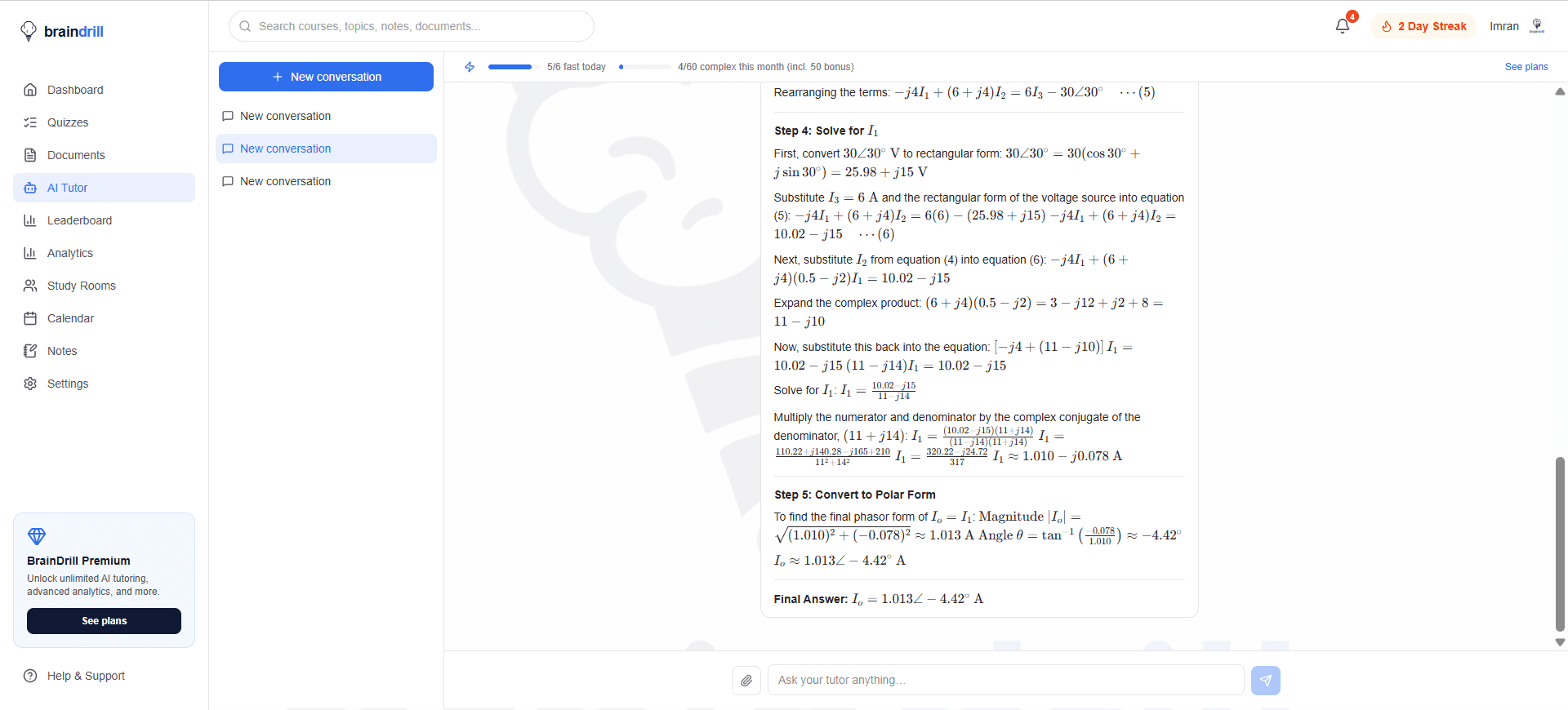
Imran Al-Ameen Adebayo
Engineering student and founder of BrainDrill — building the study app he wished he had. Read his story →
Study smarter, straight to your inbox 📬
One short email a week: a study technique that works, a topic worth drilling, and what's new in BrainDrill. Free, no spam, unsubscribe anytime.