
How to Pass Calculus 1 in College: A Survival Guide
By Imran Al-Ameen Adebayo · Founder of BrainDrill · 12 July 2026 · 6 min read

At most universities, Calculus 1 sits near the top of the "weed-out" list — failure rates of 30% and up are normal. Here's the honest part: very little of that failure is caused by calculus. It's caused by algebra, and by a study style that worked in high school and quietly stopped working.
The algebra tax
The chain rule takes an afternoon to understand. What buries students is everything around it: factoring, exponent laws, rationalising, trig identities. When your professor "skips steps", those are the steps. Diagnose yourself early — if simplifying rational expressions or manipulating exponents is slow, fix that in week one, because every later topic charges the algebra tax with interest.
Learn the idea, then automate the mechanics
The derivative is one idea: instantaneous rate of change, the slope of the tangent line. The limit definition, the rules, related rates — all one idea wearing different clothes. Students who grasp the idea can rebuild a forgotten rule; students who memorised rituals collapse the moment a problem looks unfamiliar. Then, separately, drill the mechanics — derivative rules, chain rule, limits — until they cost zero mental effort. BrainDrill's Calculus 1 bank is free and every question has a full worked solution.
The homework illusion
The most common Calc 1 death spiral: homework done "with help" — a friend, a solution manual, an AI that just hands over answers — scores fine all semester, then the first midterm lands at 42%. Help is fine; the test is whether you can redo the same problem alone from a blank page 24 hours later. If you can't, it isn't learned yet. Use explanations to understand, then always close the loop solo.
Office hours, recitation, and asking early
Professors consistently say the same thing: the students who fail are the ones they never met. Go to office hours in week two with specific questions. Between sessions, when a problem stalls you at 11pm, get a step-by-step explanation immediately — snap a photo of the problem into an AI tutor that shows and verifies its working — so a ten-minute confusion never becomes a three-week gap.
Exam preparation that actually transfers
- Rebuild a one-page formula/idea sheet from memory each week — the rebuilding is the revision.
- Do at least one full past exam (your professor's if available) timed, no notes.
- Keep an error log; before the exam, redo every logged problem cold.
- Practise the professor's notation and phrasing — familiarity reduces exam-day parsing time.
Frequently asked questions
Why do so many students fail Calculus 1?+
Mostly not because of calculus. The two killers are weak algebra/trig foundations (the derivative rules are easy; the algebra around them isn't) and passive studying — attending lectures and rereading notes without solving problems unassisted.
How many hours a week does Calculus 1 take?+
The standard rule — two to three hours outside class per credit hour — is real for calculus. For a 4-credit course, budget 8–10 hours a week, most of it solving problems, not rewatching lectures.
What should I do if I'm already behind in Calc 1?+
Triage: go straight to the current topic and fill only the gaps it needs (usually specific algebra or trig identities). Backfilling the entire prerequisite chain from page one feels virtuous but runs out the clock. Get each stuck problem explained step by step, then redo it yourself.
Put this into practice with BrainDrill
An AI tutor that shows its work step by step, quizzes generated from your own notes, and live study rooms with friends. Free to start — no card needed.
Try BrainDrill free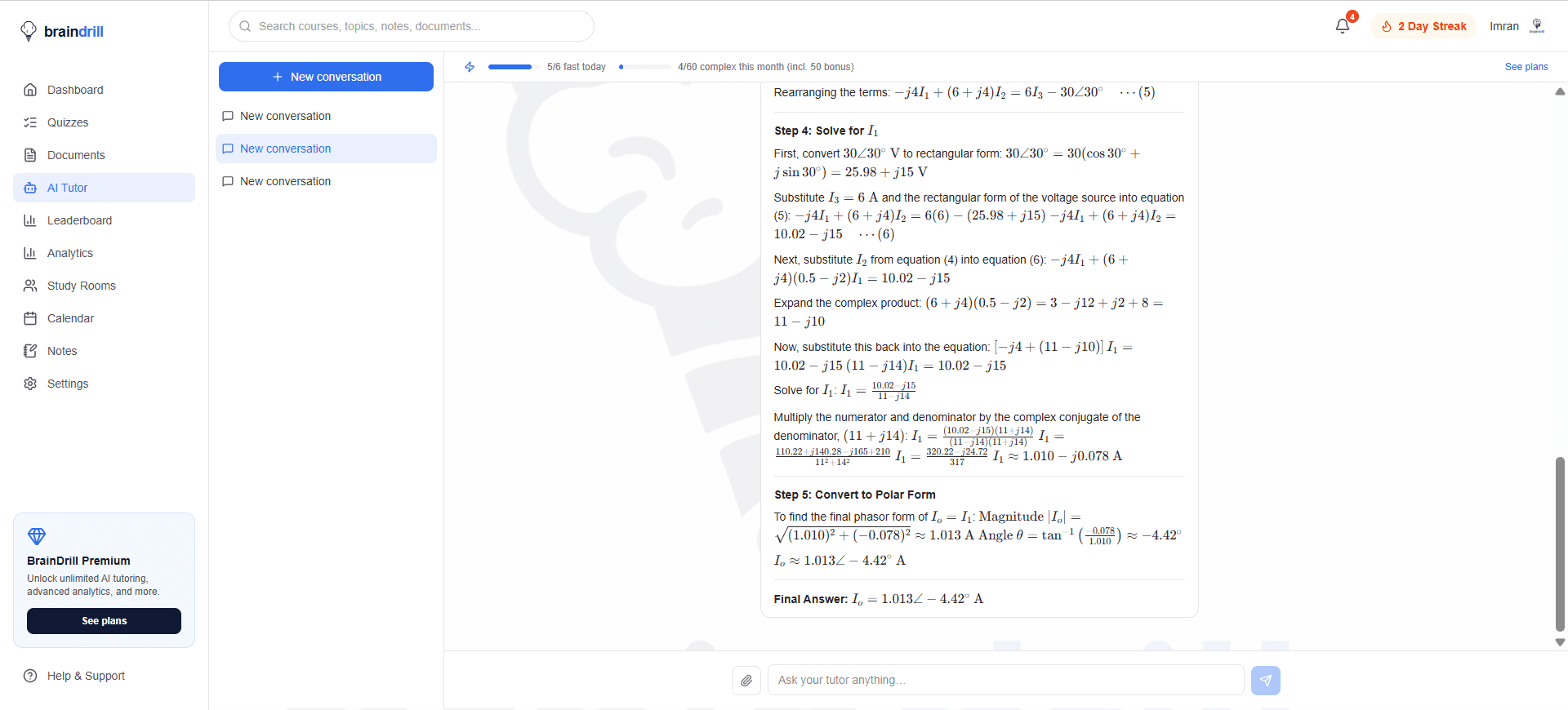
Imran Al-Ameen Adebayo
Engineering student and founder of BrainDrill — building the study app he wished he had. Read his story →
Study smarter, straight to your inbox 📬
One short email a week: a study technique that works, a topic worth drilling, and what's new in BrainDrill. Free, no spam, unsubscribe anytime.