
How to Calculate Your GPA and CGPA in a Nigerian University (5.0 Scale)
By Imran Al-Ameen Adebayo · Founder of BrainDrill · 3 July 2026 · 6 min read
Every semester, thousands of students discover their GPA from the portal with no idea how the number was produced — which also means no idea how to move it. The calculation is genuinely simple, and once you can do it yourself you can plan your semester like an engineer: knowing exactly what each course is worth before you sit it.
One caveat before the maths: most Nigerian universities use the 5-point system described here, but grading boundaries and class cutoffs are set by each institution — always confirm against your own student handbook.
The two ingredients: grade points and credit units
On the common 5-point scale, letter grades map to grade points like this:
- A (typically 70–100) → 5 points
- B (60–69) → 4 points
- C (50–59) → 3 points
- D (45–49) → 2 points
- E (40–44) → 1 point (some schools have scrapped E entirely)
- F (below 40) → 0 points
Each course also carries credit units (usually 1–6) — a weight reflecting how big the course is. A 4-unit Engineering Maths course affects your GPA twice as much as a 2-unit elective. This is the single most under-used fact in semester planning.
The formula
GPA = Σ(grade point × credit units) ÷ Σ(credit units)
Multiply each course's grade point by its units to get its quality points, add them all up, and divide by the total units you registered.
A worked example
Say your semester looked like this:
- MTH 201 (4 units) — A → 5 × 4 = 20 quality points
- GET 210 (3 units) — B → 4 × 3 = 12
- CHM 101 (3 units) — C → 3 × 3 = 9
- GST 111 (2 units) — A → 5 × 2 = 10
- PHY 102 (3 units) — D → 2 × 3 = 6
Total quality points = 20 + 12 + 9 + 10 + 6 = 57. Total units = 4 + 3 + 3 + 2 + 3 = 15. GPA = 57 ÷ 15 = 3.80.
GPA vs CGPA
GPA covers one semester. CGPAis cumulative: total quality points from ALL semesters so far, divided by ALL units so far. Note that it's not a simple average of your GPAs — a semester where you carried more units weighs more. Your CGPA determines your degree class; on the common scale:
- First Class: 4.50 – 5.00
- Second Class Upper (2:1): 3.50 – 4.49
- Second Class Lower (2:2): 2.40 – 3.49
- Third Class: 1.50 – 2.39
- Pass: 1.00 – 1.49
What this means for strategy
- Protect the heavy courses. An A in a 4-unit course adds as many quality points as As in two 2-unit courses. Allocate study time by units, not by which course you enjoy.
- Early semesters matter most.CGPA is a running average — the more units accumulate, the harder each new semester pulls it. A strong 100-level is the cheapest First Class you'll ever buy.
- Know your target before exams. Before each exam period, compute what grades you need in each course to hold (or reach) your target class. It turns vague anxiety into a concrete to-do list.
- An F never disappears quietly. Even after retaking a failed course, many schools keep the original F in the CGPA calculation. Avoiding one F is worth more than chasing two As.
Raising it is a study problem, not a maths problem
Once you know the formula, the lever is obvious: better grades in the heaviest courses. That comes down to studying methods that work — practising past questions from a blank page, turning your notes into self-tests instead of rereading them, and drilling the calculation-heavy courses under exam time. We've written practical guides on each of those on this blog, and BrainDrill itself exists to make that loop easier: an AI tutor that teaches methods step by step and quizzes generated from your own course materials.
Put this into practice with BrainDrill
An AI tutor that shows its work step by step, quizzes generated from your own notes, and live study rooms with friends. Free to start — no card needed.
Try BrainDrill free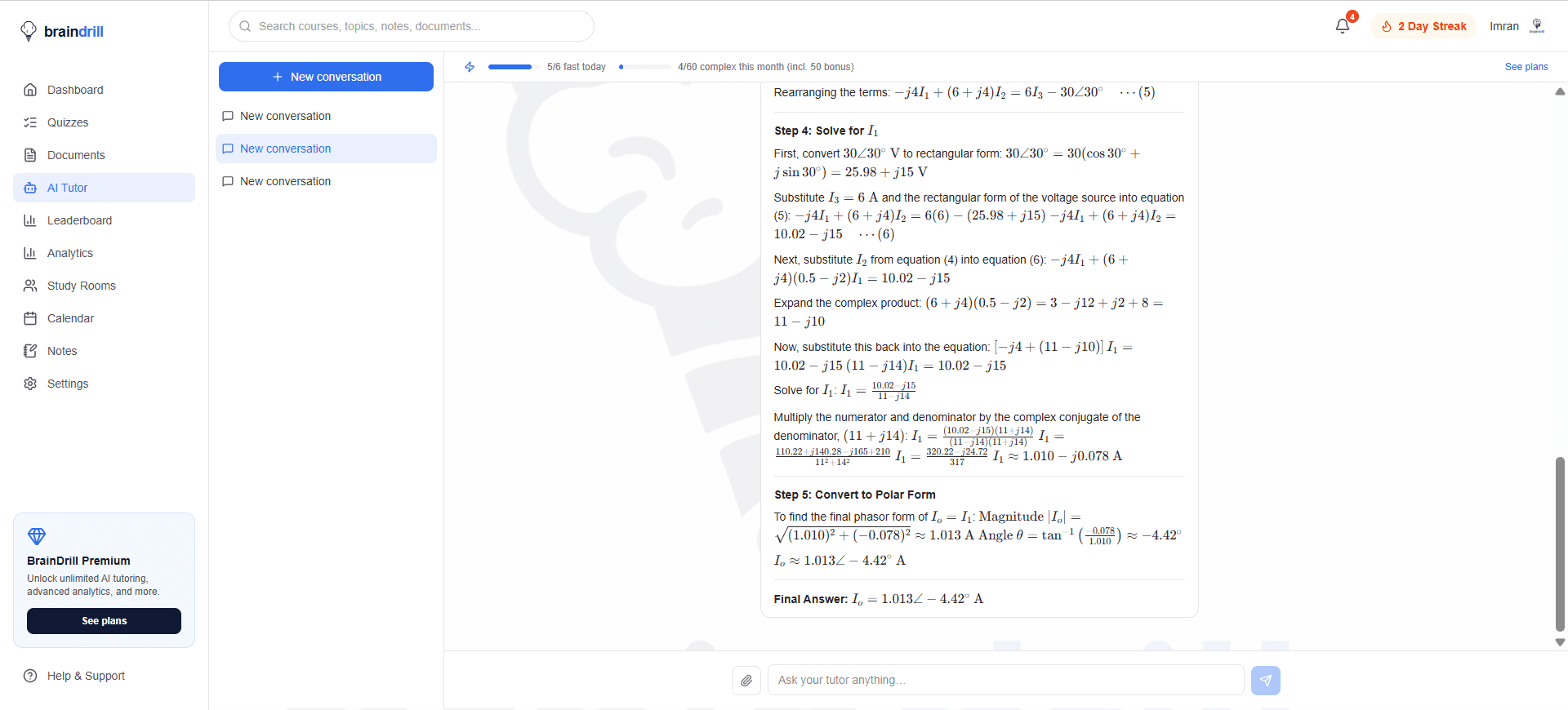
Imran Al-Ameen Adebayo
Engineering student and founder of BrainDrill — building the study app he wished he had. Read his story →
Study smarter, straight to your inbox 📬
One short email a week: a study technique that works, a topic worth drilling, and what's new in BrainDrill. Free, no spam, unsubscribe anytime.