Meet BrainDrill: Solving Nodal Analysis Step by Step
By Imran Al-Ameen Adebayo · Founder of BrainDrill · 26 August 2026 · 3 min read

Nodal analysis is one of those topics that looks simple in lecture and falls apart the moment you're staring at a blank circuit diagram on an exam. Watching someone else write KCL equations feels like understanding; writing your own, correctly, under time pressure, is a different skill entirely. This short video shows exactly how BrainDrill closes that gap.
What the video actually shows
The circuit is a three-node network with a voltage source, two resistors and a capacitor (an impedance of at the drive frequency) — small enough to work through on one screen, but with enough going on that you can't fake your way through it. BrainDrill writes the full node-voltage equation at each non-reference node before touching any algebra:
That's Node B's KCL equation, in full — every current leaving the node accounted for, nothing skipped. Node C gets the same treatment. Only after both equations are on screen does BrainDrill solve the system and state the node voltages, the same order a lecturer would work the board in — derive first, answer last.
Why the order matters
A tool that jumps straight to “” teaches you nothing about the ten seconds of decision-making that actually separates students who pass circuit analysis from students who don't: which node is the reference, which branch currents point which way, whether this is a job for nodal or mesh analysis in the first place. BrainDrill's AI tutor is built around explaining the how, not just asserting an answer — the same principle behind every worked solution across the app, not something special-cased for this one video.
Try it on your own circuit
The demo circuit is deliberately small so it fits in a two-minute clip — but the same step-by-step approach holds for a supernode, a dependent source, or a full AC phasor network. Snap a photo of a circuit from your own coursework, or type it in, and BrainDrill will work it the same way: equations first, answer last.
For the fuller picture on choosing between nodal and mesh analysis, sign conventions, and a drill plan that survives exam day, see How to Study Circuit Analysis: From KCL to Thévenin.
Frequently asked questions
What is nodal analysis?+
A systematic way to solve a circuit by writing one Kirchhoff's Current Law equation per non-reference node — every current leaving a node, in terms of node voltages, summed to zero — then solving the resulting system for each node voltage.
Does BrainDrill just give the final answer?+
No — that's the point of the video. It writes out every node equation individually (Node B, Node C, and so on), shows the algebra that solves the system, and only then states the result, the same way a lecturer would work it on a board.
Can I use this for AC circuits with impedances, not just resistors?+
Yes. The demo circuit includes a capacitor's impedance term alongside resistors — BrainDrill handles nodal analysis with complex impedances (phasors), not only purely resistive DC networks.
Put this into practice with BrainDrill
An AI tutor that shows its work step by step, quizzes generated from your own notes, and live study rooms with friends. Free to start — no card needed.
Try BrainDrill free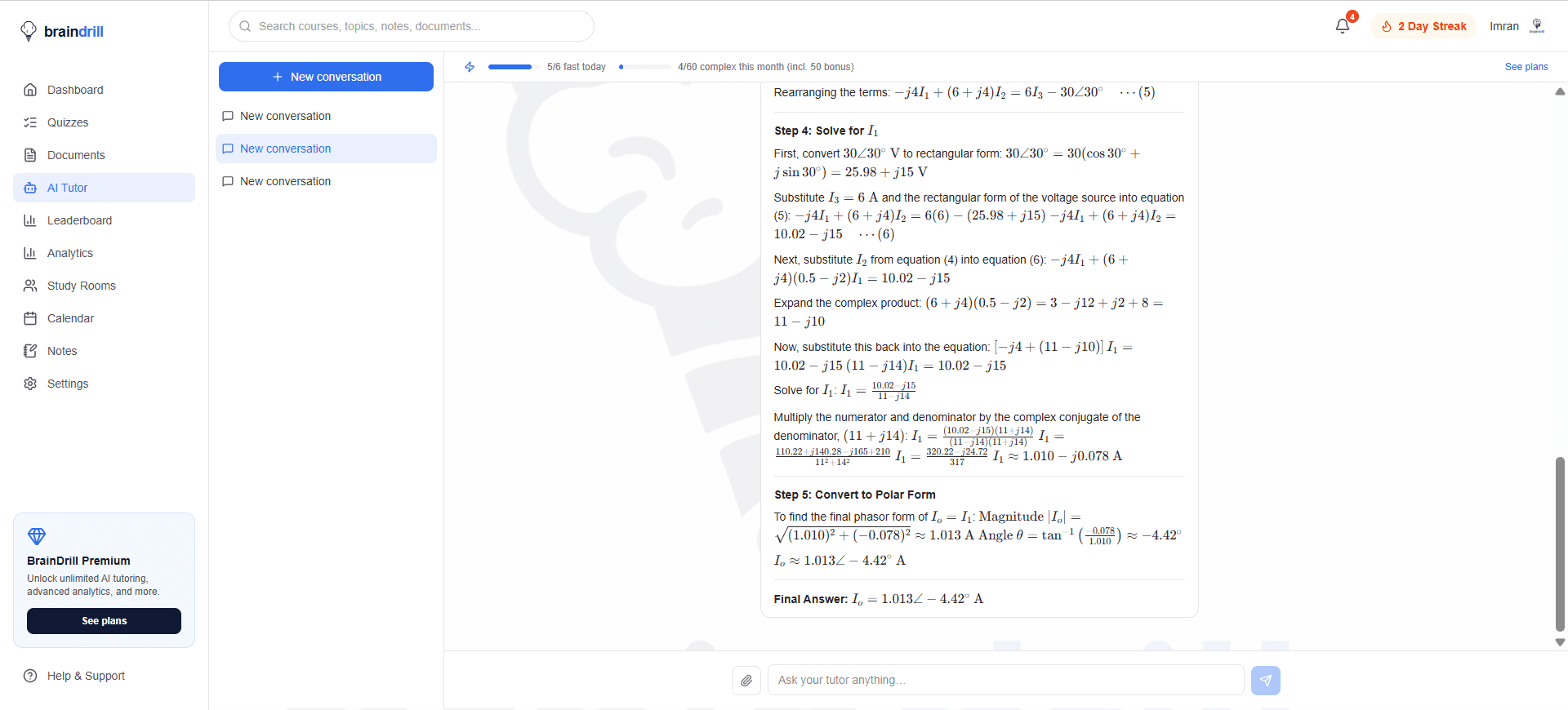
Imran Al-Ameen Adebayo
Engineering student and founder of BrainDrill — building the study app he wished he had. Read his story →
Study smarter, straight to your inbox 📬
One short email a week: a study technique that works, a topic worth drilling, and what's new in BrainDrill. Free, no spam, unsubscribe anytime.