
How to Study for AP Calculus AB: A Plan That Gets You to a 5
By Imran Al-Ameen Adebayo · Founder of BrainDrill · 12 July 2026 · 6 min read
AP Calculus AB is one of the most predictable exams you will ever take. The College Board publishes exactly what's tested, the free-response questions repeat the same handful of setups every year, and the scoring rubrics are public. That predictability is your advantage — if you study in the order the exam rewards, a 5 is a plan, not a lottery.
Learn the units in exam order, not textbook order
The exam weights differentiation and integration far more heavily than the exotic corners of your textbook. Structure your prep around the spine of the course:
- Limits and continuity — evaluating limits by factoring, rationalising, and the squeeze theorem; knowing when a limit doesn't exist.
- Derivatives — the rules until they're reflex (power, product, quotient, chain), then implicit differentiation.
- Applications of derivatives — related rates, optimisation, curve behaviour from f′ and f″. This is where 5s are separated from 3s.
- Integration — antiderivatives, definite integrals, u-substitution, and the Fundamental Theorem of Calculus.
You can drill every one of these topics free in BrainDrill's AP Calculus AB practice bank — each question comes with a full step-by-step solution, so a wrong answer teaches you something instead of just costing you.
The 40/60 rule: learn less, solve more
The single biggest mistake AP students make is spending 80% of their time watching videos and rereading notes. Flip it: at most 40% of your study time on input, at least 60% on actually solving problems with the solution hidden. Retrieval is what builds the speed the multiple-choice section demands — 45 questions in 105 minutes leaves no time to derive things from first principles.
Free-response: write like the rubric reads
Graders award points for specific things: the setup, the work, the answer and the justification sentence. "The function is increasing because f′(x) > 0 on the interval" is a point; a bare "increasing" often isn't. When you practise, write full responses and compare them against real released rubrics — not just the final number.
When you're stuck, get unstuck in minutes — not days
The classic failure loop: you hit a related-rates problem you can't start, skip it, and that topic quietly becomes a permanent gap. Break the loop by getting an explanation immediately — snap the problem into an AI tutor that shows its work step by step, then redo the same problem yourself from a blank page. Understanding someone else's solution and producing your own are different skills; the exam only tests the second.
The last two weeks
- Take at least two full timed practice exams — the stamina is trainable.
- Keep an error log: every miss, one line on why. Revise the log, not the textbook.
- Drill your weakest two topics daily — ten questions each, no more.
- Sleep. A tired brain does algebra slowly, and AB is a speed exam.
Frequently asked questions
How long should I study for AP Calculus AB?+
If you're starting 8+ weeks out, one focused hour a day is enough: two weeks on limits and continuity, three on differentiation and its applications, three on integration. Starting later, cut breadth not depth — the derivative and integral units carry most of the marks.
What's the hardest part of AP Calculus AB?+
Most students lose marks on applications, not mechanics: related rates, optimisation, and interpreting the meaning of a derivative or definite integral in context. Practising word problems — and writing out the justification sentences the graders want — matters more than doing another hundred pure derivatives.
Can I prepare for AP Calc AB without a tutor?+
Yes — the syllabus is public, past free-response questions are free, and an AI tutor can walk you through any step you don't understand. What you can't skip is doing problems yourself under time pressure.
Put this into practice with BrainDrill
An AI tutor that shows its work step by step, quizzes generated from your own notes, and live study rooms with friends. Free to start — no card needed.
Try BrainDrill free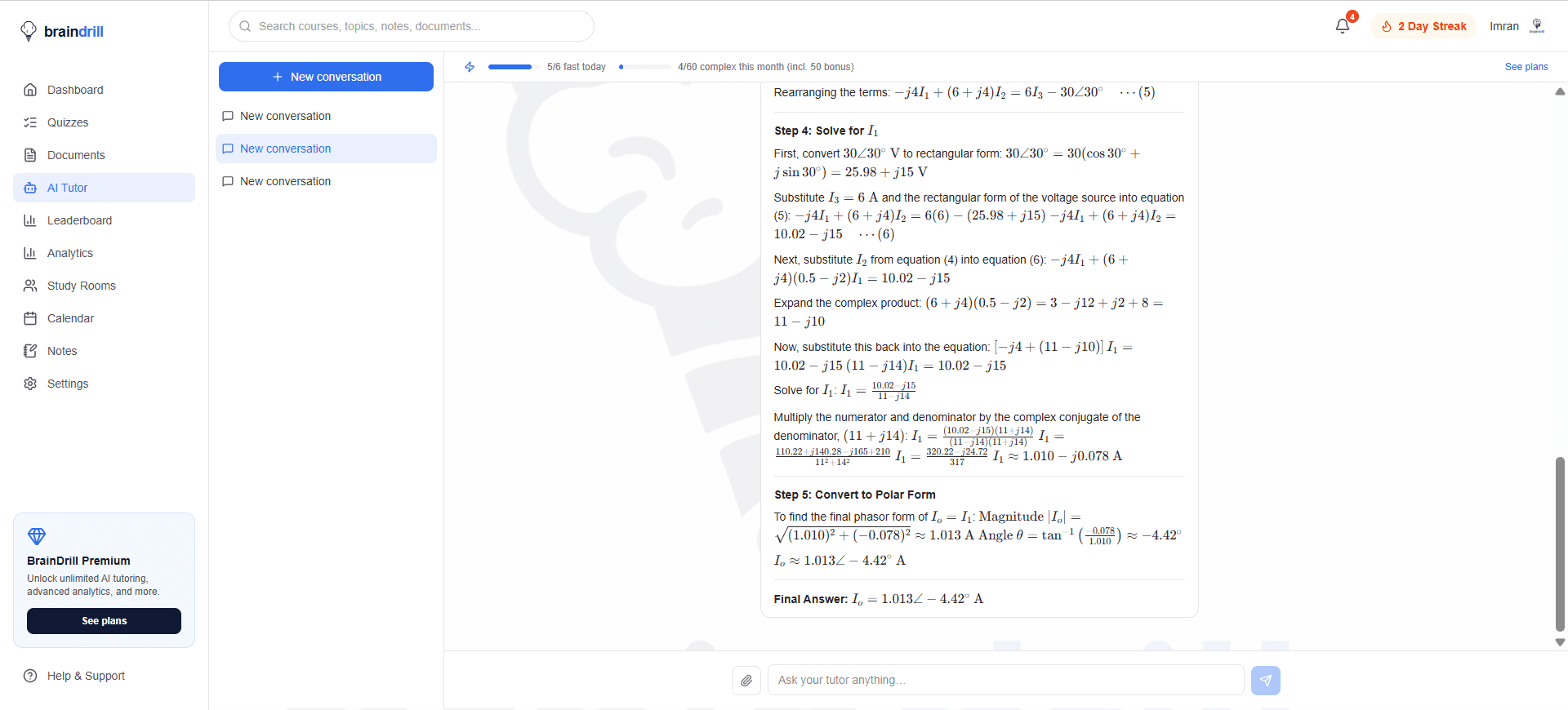
Imran Al-Ameen Adebayo
Engineering student and founder of BrainDrill — building the study app he wished he had. Read his story →
Study smarter, straight to your inbox 📬
One short email a week: a study technique that works, a topic worth drilling, and what's new in BrainDrill. Free, no spam, unsubscribe anytime.