
SAT Math Prep: How to Raise Your Score 100+ Points
By Imran Al-Ameen Adebayo · Founder of BrainDrill · 12 July 2026 · 6 min read

SAT Math rewards a strange skill: doing moderately hard algebra fast and without careless errors. There are no surprises on this test — the College Board recycles the same question families every administration. Your prep should exploit that ruthlessly.
Know the four families
- Algebra — linear equations and systems, inequalities, interpreting slope and intercepts. The biggest slice of the test.
- Advanced math — quadratics in every costume: factoring, the discriminant, vertex form, plus radical and rational equations.
- Problem-solving & data — percentages, ratios, unit conversion, reading scatterplots and tables.
- Geometry & trig — a handful of questions: circles, triangles, SOHCAHTOA.
Start by drilling the first two families until they're automatic — they're where the points live. BrainDrill's SAT Math practice bank has exam-style questions for each family with full worked solutions, free.
The error log is the whole secret
Everyone does practice questions. Score-raisers do something extra: every single miss goes into an error log with one line — what family, what trap, what I'll do differently. "Distributed the negative wrong in a linear equation." "Forgot to check for extraneous solutions in a radical equation." After two weeks the log IS your syllabus: it tells you exactly which ten question types cost you points, and you drill those, not everything.
Speed comes from method, not rushing
The digital SAT gives you roughly 95 seconds per question. The students who finish comfortably aren't faster thinkers — they recognise the setup instantly because they've seen it fifty times. That recognition only comes from volume of practice. When a question stumps you, don't stare: get a step-by-step explanation immediately (an AI tutor that shows its working is perfect for this), then redo the question cold the next day.
A weekly rhythm that works
- Mon–Thu: 30–40 minutes of targeted drilling on your two weakest families.
- Fri: review the week's error log; redo every logged question from scratch.
- Sat: one timed module under real conditions — no pausing, Desmos allowed.
- Sun: off. Consistency beats heroics.
Two traps that cost real points
Trap one: solving for the wrong thing. The SAT loves asking for "the value of 3x" after you've solved for x. Underline what's asked before you start. Trap two: answer-choice tunnel vision. On hard questions, plugging the answer choices back in is often faster than solving forward — the test doesn't award style points.
Frequently asked questions
How long does it take to improve SAT Math by 100 points?+
For most students, 6–10 weeks of consistent practice (45–60 minutes a day) is realistic for a 100-point Math section gain — if the time is spent solving and reviewing errors, not passively watching prep videos.
What math is actually on the SAT?+
Roughly: algebra (linear equations, systems, inequalities), advanced math (quadratics, exponentials, radicals, rational equations), problem-solving and data analysis (ratios, percentages, statistics), and a small amount of geometry and trigonometry. Linear and quadratic algebra dominate.
Is the digital SAT math section easier?+
It's shorter and adaptive, and the built-in Desmos calculator helps — but the second module gets harder if you do well in the first, so top scores still require speed and accuracy on the hardest question types.
Put this into practice with BrainDrill
An AI tutor that shows its work step by step, quizzes generated from your own notes, and live study rooms with friends. Free to start — no card needed.
Try BrainDrill free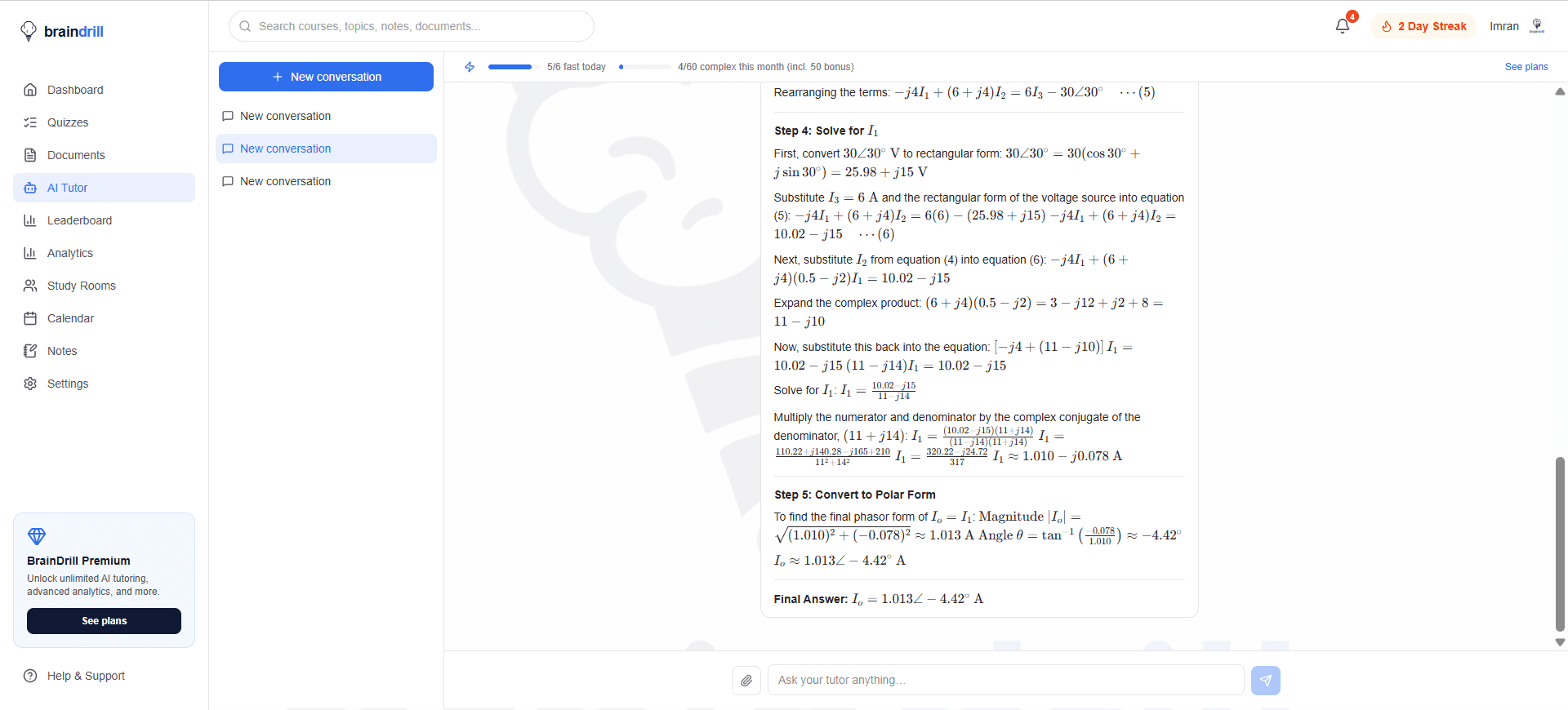
Imran Al-Ameen Adebayo
Engineering student and founder of BrainDrill — building the study app he wished he had. Read his story →
Study smarter, straight to your inbox 📬
One short email a week: a study technique that works, a topic worth drilling, and what's new in BrainDrill. Free, no spam, unsubscribe anytime.