
Matric Maths (NSC): How to Lift Your Mark Before Finals
By Imran Al-Ameen Adebayo · Founder of BrainDrill · 12 July 2026 · 6 min read

Matric finals reward the learner who knows exactly what the two papers ask and has rehearsed them until the format is boring. NSC Mathematics is remarkably consistent year to year — which means a focused final stretch can move your mark by a symbol or two. Here's the system.
Know the two papers cold
- Paper 1: algebraic expressions and equations, number patterns and sequences, functions and graphs (parabola, hyperbola, exponential), finance (growth and annuities), differential calculus (from first principles to cubic graphs), probability.
- Paper 2: statistics and regression, analytical geometry, trigonometry (identities, equations, 2-D/3-D problems), and Euclidean geometry with its circle theorems.
Map your last three test results onto this list and revision priorities choose themselves. Algebra weakness leaks into everything on Paper 1 — repair it first with step-by-step quadratic practice and equation drills.
The past-paper + memo cycle
One paper (or half-paper) weekly under timed, phone-in-another-room conditions; then mark with the official memo, awarding method marks honestly. Log every dropped mark — topic, cause, fix — and spend the following sessions repairing those exact topics with fresh questions. From September onward this cycle IS the study plan; textbooks become reference, not reading.
Euclidean geometry: the section learners abandon (don't)
Circle geometry feels unlearnable because it's taught as theorems to memorise. It's actually a small toolkit — tan-chord, angles in the same segment, cyclic quadrilaterals — combined in chains. Write the toolkit on one page, then practise finding the chain on past-paper riders: mark every equal angle on the diagram, state the reason, and the path usually reveals itself two steps in. Ten riders with full reasons beat fifty read solutions.
Show working like the memo is watching
NSC memos award marks per step: the substitution, the simplification, the answer. A correct answer with no working can lose most of its marks; a wrong answer with correct method keeps most of them. Write the formula first, substitute visibly, and never do two algebra moves in one line during finals.
When there's no tutor for 50 km
The gap between learners with tutors and without is really a gap in unstuck speed. A phone plus an AI tutor that explains any snapped question step-by-step — at night, in data-light mode — closes most of it. Ask, understand, then re-solve from blank paper: the re-solve is the part that raises marks. Pair it with one study-group session a week (or an online study room when transport is the obstacle) and the system holds anywhere.
The final three weeks
No new topics. Cycle papers, revise the error log, re-solve logged questions cold, and rehearse the exam-day routine — including sleep. Matric is won in the weeks of boring repetition nobody posts about.
Frequently asked questions
What's the difference between NSC Maths Paper 1 and Paper 2?+
Paper 1 is algebra country: equations and inequalities, patterns and sequences, functions and graphs, finance, differential calculus and probability. Paper 2 is geometry country: statistics, analytical geometry, trigonometry and Euclidean geometry. Learners are usually stronger in one — revision time should lean toward the weaker paper.
Should I take Maths or Maths Literacy?+
If your intended course (engineering, science, commerce at most universities, medicine) requires Mathematics, Maths Literacy closes those doors — check the university's requirements before Grade 10 subject choices if possible, and before dropping down in Grade 11/12. If you're already in Matric with Mathematics, the answer is to strengthen it, not switch.
Are past papers enough to pass Matric Maths?+
The DBE publishes years of past papers with memos, and the exam recycles its topic structure faithfully — so past papers plus honest memo-marking plus repair of what you got wrong is the strongest known preparation. Casual paper-flipping without the memo step moves nothing.
Put this into practice with BrainDrill
An AI tutor that shows its work step by step, quizzes generated from your own notes, and live study rooms with friends. Free to start — no card needed.
Try BrainDrill free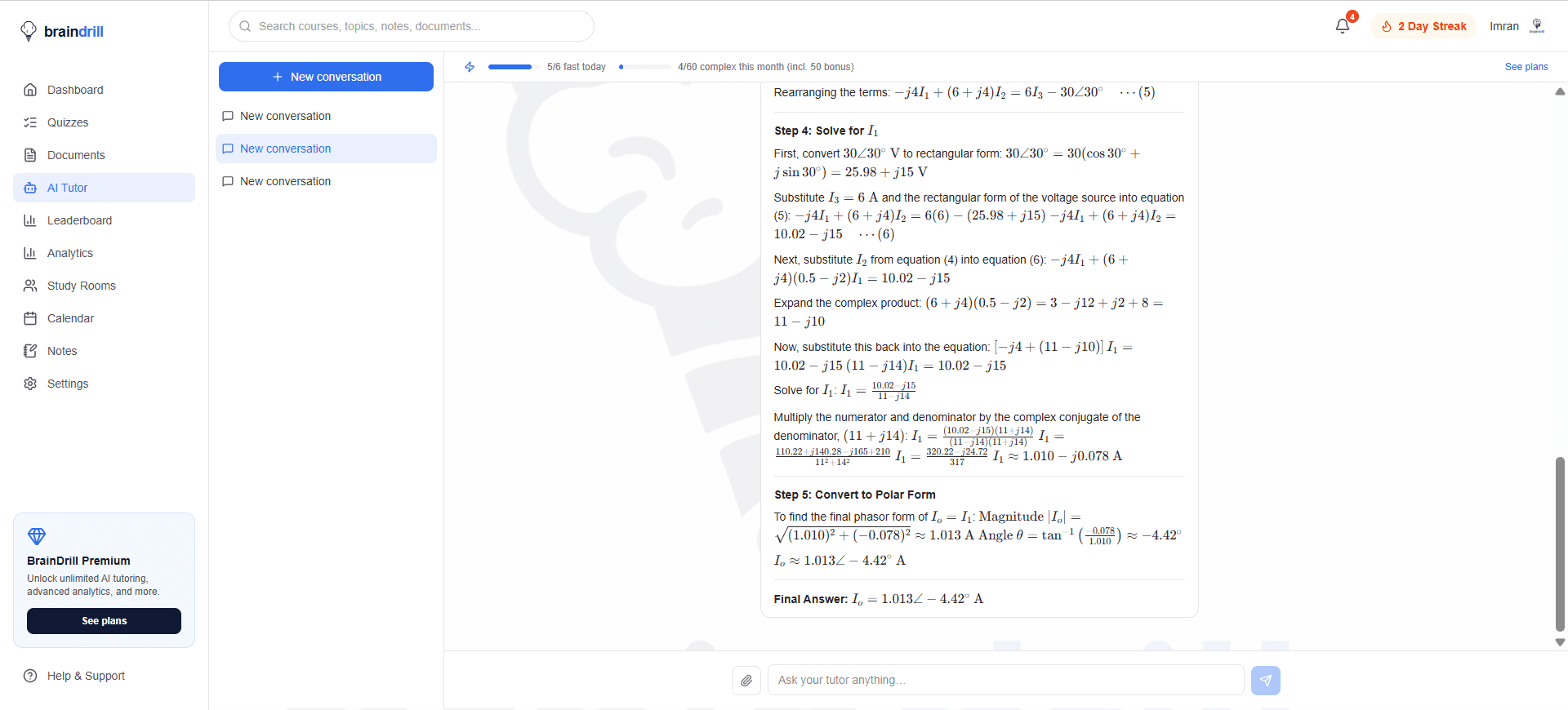
Imran Al-Ameen Adebayo
Engineering student and founder of BrainDrill — building the study app he wished he had. Read his story →
Study smarter, straight to your inbox 📬
One short email a week: a study technique that works, a topic worth drilling, and what's new in BrainDrill. Free, no spam, unsubscribe anytime.