
Online Tutors in Nigeria: Your Real Options (Human and AI)
By Imran Al-Ameen Adebayo · Founder of BrainDrill · 3 July 2026 · 6 min read
Whether it's a 200-level engineering course going badly or WAEC/JAMB prep for a younger sibling, at some point most Nigerian students go looking for a tutor online. Here's an honest map of the options — including where a human tutor is genuinely worth the money, and where an AI tutor now does the job for a fraction of it.
Option 1: Human tutors online
Students typically find them through:
- Tutoring platforms and agencies that match tutors to students for online (or in-home) lessons across Nigerian cities.
- Senior colleagues and course reps — often the best value in a university setting, because they sat the same exams with the same lecturers.
- Departmental WhatsApp groups and campus noticeboards, where tutorial groups form each semester.
Costs vary widely — by city, level, and subject — but the structure is always the same: you pay per hour or per session, so weekly help through a semester adds up to a significant recurring expense. That money buys real things: accountability, a human who notices your confusion before you voice it, and exam-specific local knowledge. For a student who struggles to study alone at all, a good human tutor (or a serious tutorial group) can be the difference-maker.
Option 2: AI tutoring
What an AI tutor does better than any human arrangement:
- It's there at 1am — which is when the assignment is actually due and the confusion actually strikes. No scheduling, no waiting for Saturday's session.
- Unlimited patience. You can ask the same question four ways without managing anyone's mood, in English, Pidgin, Yorùbá, Hausa, Igbo, or whatever language you think in.
- Cost. A month of AI tutoring costs less than a single human session — BrainDrill's free plan includes real daily tutoring, and paid plans start at $3.99/month (shown in naira when you're paying from Nigeria).
- Every step written down. The explanation doesn't evaporate when the session ends; you can reread the working tomorrow.
What it honestly doesn't do:
- Chase you. No AI will call to ask why you skipped three days. Accountability has to come from you, a timetable, or a study group.
- Know your lecturer. A senior colleague knows that Dr. A always sets question 7b. Feed the AI your past questions and it closes most of that gap — but the local intelligence arrives with you, not with it.
The honest decision guide
- Struggling with specific problems and topics? AI tutor first. This is its home ground — step-by-step methods, on demand, at student prices.
- Struggling to study at all? Human structure first — a tutorial group, a study partner, or a paid tutor whose appointment you won't skip. Add AI for the between-session questions.
- Big exam, limited budget? A hybrid most students land on: past questions + AI tutoring daily, and if the budget allows, a few targeted human sessions on your two weakest topics rather than a standing weekly booking.
Whatever you choose, apply the same test
Human or AI, a tutor is working if — and only if — you can solve problems alone afterwards. After every session, re-solve the problems from a blank page. If that keeps failing, change something: the tutor, the format, or the amount of active practice between sessions. Tutoring you can't reproduce without help isn't tutoring; it's company.
Put this into practice with BrainDrill
An AI tutor that shows its work step by step, quizzes generated from your own notes, and live study rooms with friends. Free to start — no card needed.
Try BrainDrill free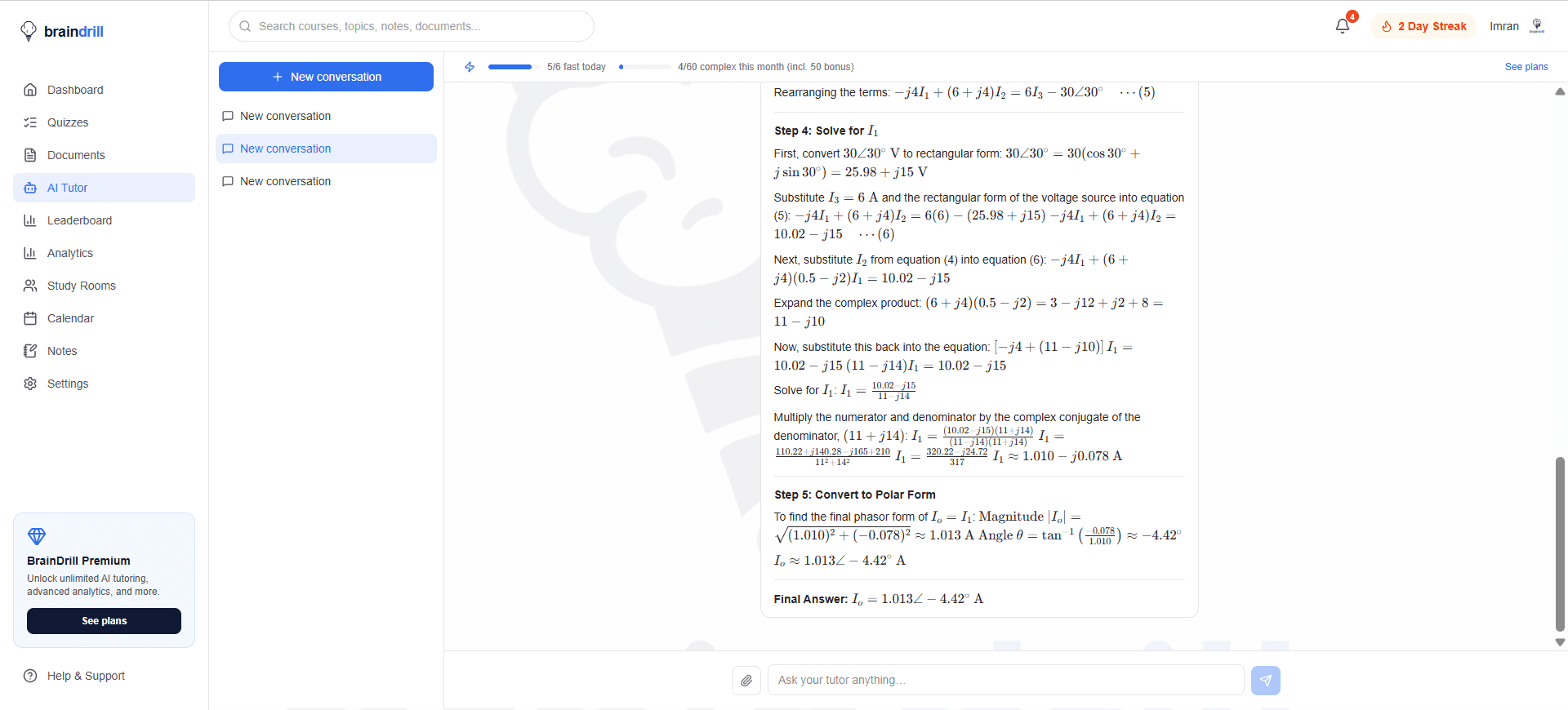
Imran Al-Ameen Adebayo
Engineering student and founder of BrainDrill — building the study app he wished he had. Read his story →
Study smarter, straight to your inbox 📬
One short email a week: a study technique that works, a topic worth drilling, and what's new in BrainDrill. Free, no spam, unsubscribe anytime.