
The Best AI Study Apps in 2026 (An Honest Comparison)
By Imran Al-Ameen Adebayo · Founder of BrainDrill · 12 July 2026 · 6 min read

Every app store search for "AI study app" now returns hundreds of results, most of them the same chatbot in different clothes. Here's an honest map of the landscape in 2026 — what each category genuinely does well, where it falls short, and how to assemble a stack that makes you smarter instead of just faster at homework.
Category 1: AI tutors (explain-anything apps)
The strongest use case in the entire space. A good AI tutor answers the 11pm "why did the sign flip?" question in thirty seconds — the question that used to cost a week of waiting for office hours. What separates the good ones: step-by-step teaching (not answer dumps), properly rendered math (KaTeX, not ASCII soup), support for photos of your actual problem, and answers in your language. Weakness of the category: a tutor that only answers questions won't organise your studying — pair it with retrieval practice.
Category 2: quiz generators (notes-to-practice apps)
Memory research is unambiguous: testing yourself beats rereading. Tools that turn your own lecture notes or PDFs into practice questions put that finding on tap. Judge them on whether questions come from your material (not a generic bank), whether explanations accompany every answer, and whether costs are transparent when documents get big. Weakness: auto-generated questions can drift shallow — the best tools let you set difficulty and question mix.
Category 3: flashcards and spaced repetition
The veterans (Anki and its descendants) remain unbeatable for pure memorisation — anatomy, vocabulary, dates. AI has upgraded card creation (paste notes, get cards), but the algorithm doing the scheduling was always the point. Weakness: flashcards teach recall, not problem-solving; they cannot carry a calculus or circuits course alone.
Category 4: all-in-one study platforms
The newest category — and where BrainDrill lives — combines the tutor, the quiz generator, games that make drilling repeatable, live study rooms with friends, and progress tracking in one place. The honest pitch for all-in-ones: the pieces reinforce each other (the tutor explains what the quiz exposed; the games re-drill it), and one subscription replaces three. The honest caveat: no single app is best-in-class at everything — if your entire degree is memorisation, a dedicated spaced-repetition tool still deserves a slot beside it.
How to actually choose
- Match the tool to your bottleneck. Stuck on concepts → AI tutor. Passive rereading → quiz generator. Forgetting facts → spaced repetition. Studying alone and hating it → study rooms.
- Demand readable math. If an app shows you "sqrt(x)*ln(x)" instead of proper notation, it will teach you to misread mathematics. This is a dealbreaker for STEM.
- Check the free tier honestly. A good app proves its value before asking for money.
- Watch for cost transparency. AI features cost the provider real money; apps that show you exactly what each AI action costs respect you more than apps that quietly drain a wallet.
The rule that makes any of these work
Tools don't study; systems do. Whichever stack you pick, run it inside the loop that actually produces grades: attempt honestly → get unstuck fast → re-solve from blank paper → re-test yourself days later. AI compresses every step of that loop. It cannot replace the loop.
Frequently asked questions
Do AI study apps actually improve grades?+
The evidence supports two mechanisms: instant unblocking (confusion resolved in minutes instead of festering for a week) and retrieval practice (quizzing beats rereading by a wide margin in memory research). Apps that deliver those two things help; apps that just answer your homework don't.
What's the difference between an AI tutor and just using a chatbot?+
Purpose-built tutors add the scaffolding a raw chatbot lacks: step-by-step teaching rather than answer-dumping, rendered math notation, your own notes as context, practice generation from what you're studying, and progress tracking. A general chatbot can explain things, but it won't run your study system.
How do I use AI without cheating myself?+
One rule covers it: AI explains, you re-produce. If a tool showed you a solution, the session isn't over until you've solved the same problem from blank paper. Used that way AI accelerates learning; used as an answer machine it quietly replaces it.
Put this into practice with BrainDrill
An AI tutor that shows its work step by step, quizzes generated from your own notes, and live study rooms with friends. Free to start — no card needed.
Try BrainDrill free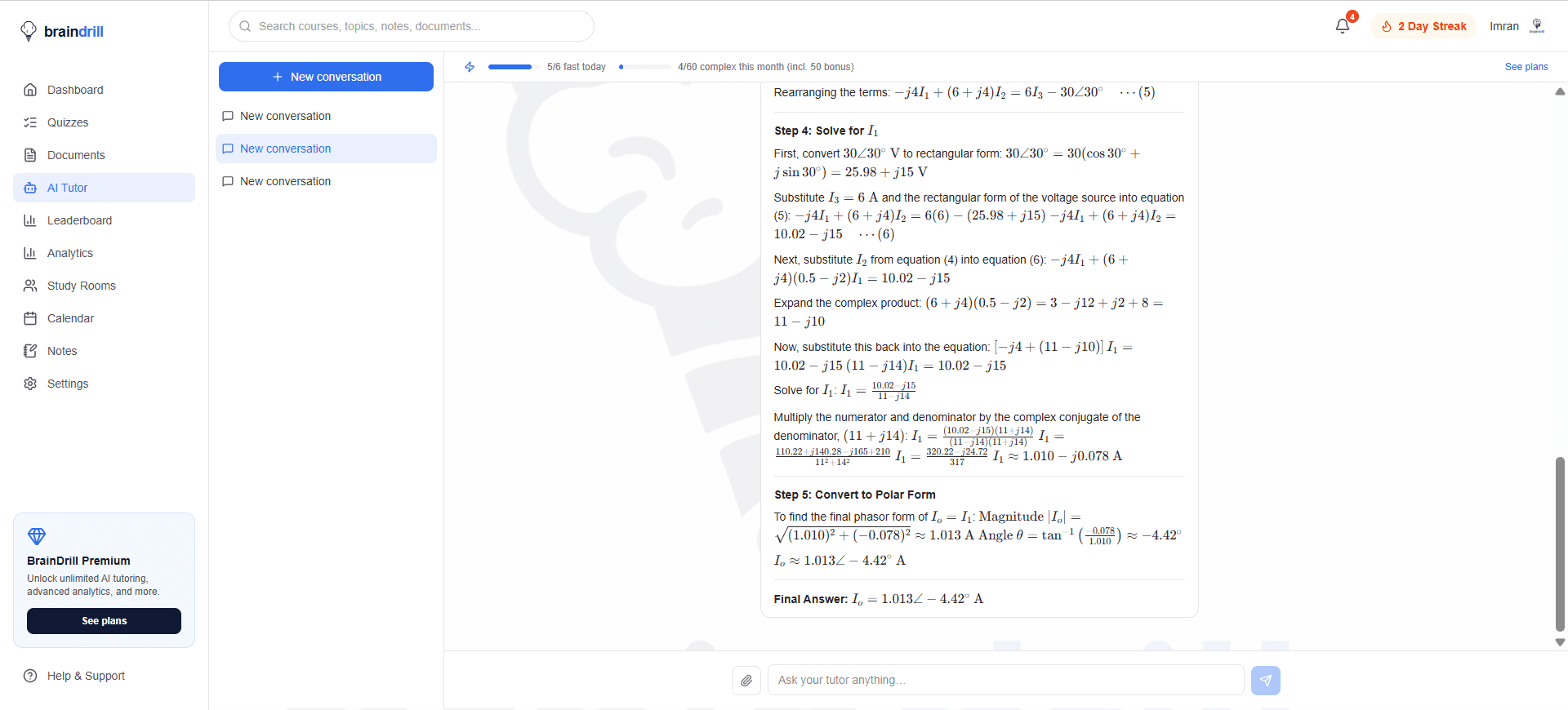
Imran Al-Ameen Adebayo
Engineering student and founder of BrainDrill — building the study app he wished he had. Read his story →
Study smarter, straight to your inbox 📬
One short email a week: a study technique that works, a topic worth drilling, and what's new in BrainDrill. Free, no spam, unsubscribe anytime.