
Best AI Tools for University Students (2026): An Honest Guide
By Imran Al-Ameen Adebayo · Founder of BrainDrill · 3 July 2026 · 6 min read

There are hundreds of “AI for students” tools now, and most lists just rank whoever paid for the placement. This one is organised by the job you actually need done, with honest notes on what each category is good and bad at — so you pick tools that make you better at your course, not just tools that produce answers.
1. General-purpose AI assistants
What they're for: broad questions, drafting, summarising, brainstorming. Tools like ChatGPT and Gemini are remarkably capable generalists. The catch for studying:they'll happily hand you a finished answer with no method, they don't remember your course or test you on it, they can be confidently wrong on calculations, and the genuinely useful tiers cost around $20/month — a price set in San Francisco, not for a student on a data bundle.
2. AI note & document tools
What they're for: summarising long readings, chatting with a PDF, organising research. Genuinely useful for literature-heavy courses. The catch:summarising is not the same as learning. A summary you read is still passive; it doesn't make you able to reproduce the material in an exam.
3. Flashcard & memorisation apps
What they're for:vocabulary, definitions, spaced repetition of discrete facts. Excellent for language learning, anatomy terms, and anything that's pure recall. The catch:flashcards struggle with multi-step problems — you can't flashcard your way through a Thévenin equivalent or a thermodynamics derivation.
4. AI study apps (tutor + practice in one)
What they're for: the actual work of understanding and practising a course — getting problems explained step by step and testing yourself on your own material. This is the category built specifically for studying rather than adapted from something else.
How to choose without wasting money or data
- Does it teach the method, or just give answers? The method is what exams test.
- Can it test you from YOUR notes? Retrieval practice is the highest-return study activity there is.
- Does it verify its own calculations? A wrong answer you re-Googled cost you twice the data and twice the time.
- Is it light on data and priced for you? Local-currency pricing and a real free tier matter more than a feature list.
Where BrainDrill fits
Full disclosure: BrainDrill is our tool, and it lives in category 4. We built it because the general assistants don't teach method, verify answers, or test you from your own materials — and they're priced for a different continent. BrainDrill's AI tutor solves problems step by step and checks its answers before showing them, its quizzes are generated from your own notes and past questions (with graded theory), it has offline notes and study rooms, and it runs light on mid-range phones with local-currency pricing and a free-forever plan. Whatever you choose, judge it against the four questions above.
Put this into practice with BrainDrill
An AI tutor that shows its work step by step, quizzes generated from your own notes, and live study rooms with friends. Free to start — no card needed.
Try BrainDrill free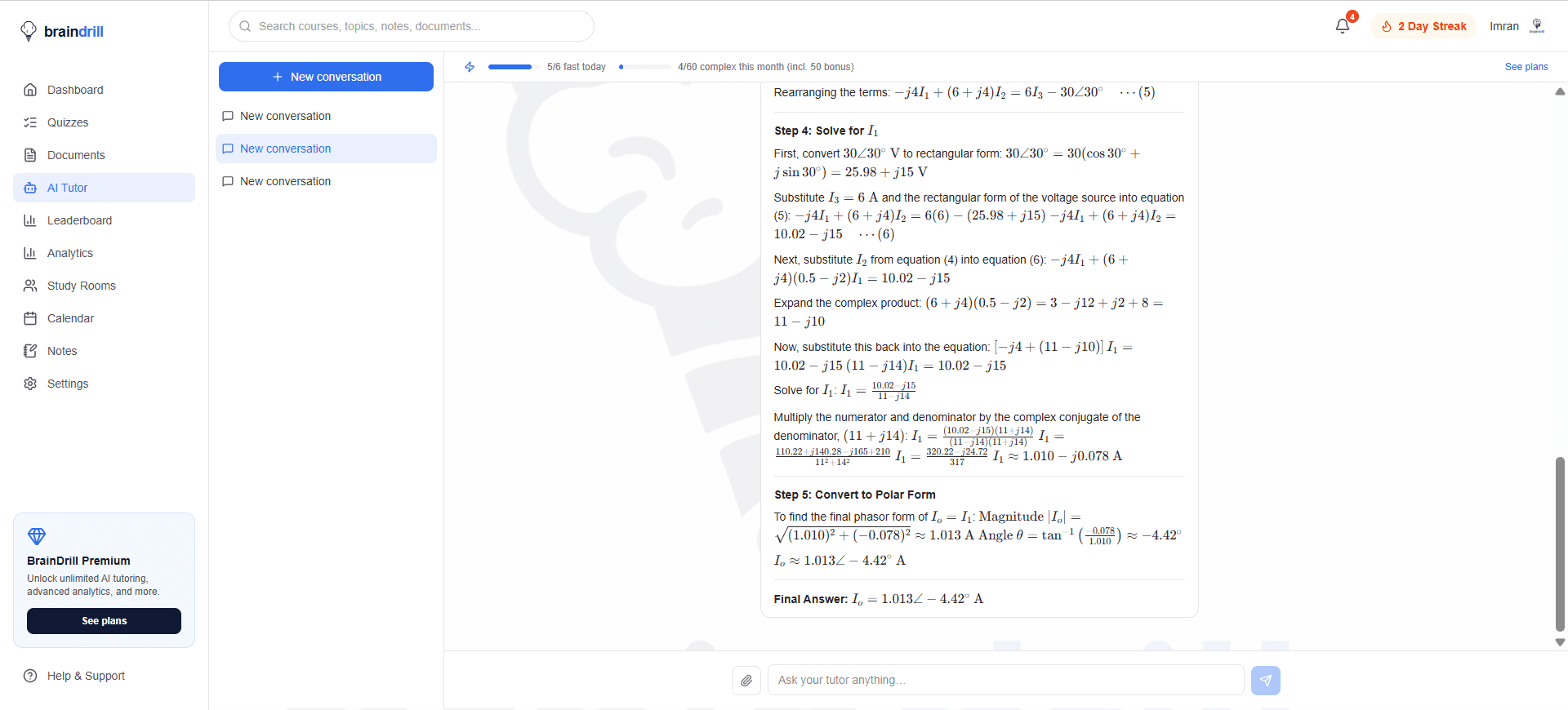
Imran Al-Ameen Adebayo
Engineering student and founder of BrainDrill — building the study app he wished he had. Read his story →
Study smarter, straight to your inbox 📬
One short email a week: a study technique that works, a topic worth drilling, and what's new in BrainDrill. Free, no spam, unsubscribe anytime.