
IB Math AA vs AI: Which to Choose and How to Score a 7
By Imran Al-Ameen Adebayo · Founder of BrainDrill · 12 July 2026 · 6 min read

The IB gives you four distinct maths products — AA and AI, each at SL and HL — and the choice quietly shapes both your two years and your university options. Here's the decision made simple, and the study system that produces 6s and 7s in any of them.
Choose with the endpoint, not the ego
- AA HL — required or preferred for engineering, physics, pure maths and many CS courses. Heavy on calculus and algebraic manipulation; some proof.
- AA SL — the balanced pure track; fine for most science-adjacent degrees that don't demand HL.
- AI HL — statistics, modelling and calculus-with-technology; accepted by many economics/business programmes (check each one).
- AI SL — for degrees where maths is a supporting tool; the lightest load.
Rule of thumb: look up three real university course pages first. If any says "Mathematics: Analysis and Approaches," your decision is made.
The 7 system (works for all four variants)
- Master the calculator early. IB papers are built around your GDC — graphing to solve equations, table scanning, statistics menus. Fluency there is worth close to a grade.
- Question banks over notes. IB rewards pattern exposure; past-paper questions by topic beat rereading the textbook every time. Drill core skills like differentiation and quadratics until mechanical.
- Respect the command terms. "Hence" means use the previous part; "show that" means every step visible; "hence or otherwise" means the previous part is the fast route. Marks die to ignored command terms daily.
- Error log, always. One line per dropped mark: topic, cause, fix. Your final-month revision is the log, not the syllabus.
Don't sleep on the IA
The Internal Assessment is 20% of your grade and the only part you fully control. Pick a topic with genuine personal engagement and real mathematics (not a biography of a formula), start a term earlier than feels necessary, and get one full draft reviewed. A strong IA turns exam-day 6s into final 7s.
Paper strategy
Long questions ramp within themselves — part (a) is often two easy marks even when (d) is brutal. Sweep every paper for early parts before wrestling anything hard, and never leave a "write down" question blank: those are gifts, by design.
Frequently asked questions
What's the real difference between AA and AI?+
Analysis & Approaches (AA) is the traditional pure-math track — algebra, calculus, proof — built for students heading into engineering, physical sciences or mathematics. Applications & Interpretation (AI) emphasises modelling, statistics and technology, suiting economics, business, social and life sciences.
Do universities care which one I take?+
Yes, more than most students realise: many engineering and physical-science programmes explicitly require AA (often HL), and some competitive economics courses prefer AA too. Check the actual entry requirements of three target universities before choosing — not forum rumours.
Is a 7 in AI SL easier than a 6 in AA HL?+
Grade boundaries adjust for difficulty, but the workload gap is real: AA HL is among the heaviest IB subjects. If your target course accepts AI or AA SL, taking the harder option purely for prestige is a common and costly mistake.
Put this into practice with BrainDrill
An AI tutor that shows its work step by step, quizzes generated from your own notes, and live study rooms with friends. Free to start — no card needed.
Try BrainDrill free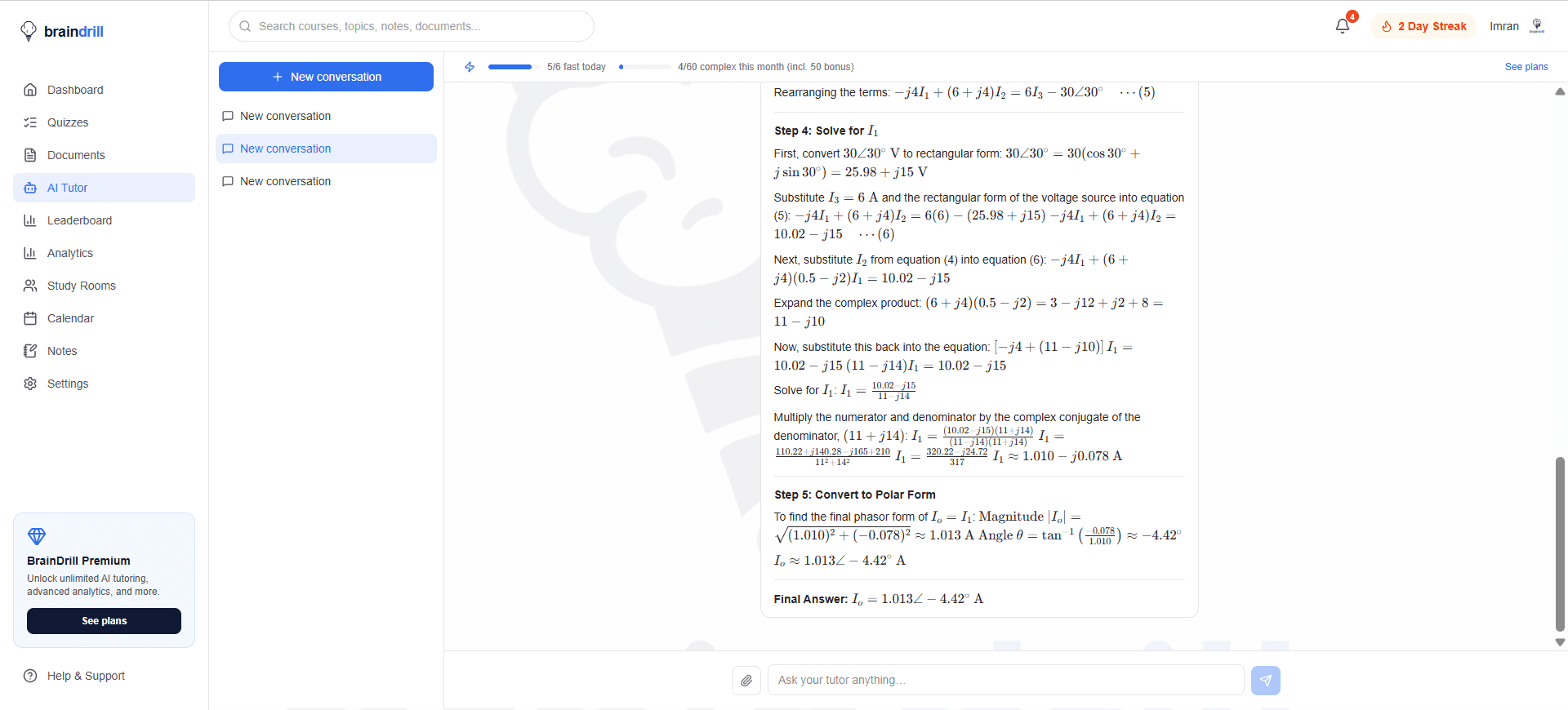
Imran Al-Ameen Adebayo
Engineering student and founder of BrainDrill — building the study app he wished he had. Read his story →
Study smarter, straight to your inbox 📬
One short email a week: a study technique that works, a topic worth drilling, and what's new in BrainDrill. Free, no spam, unsubscribe anytime.