
GCSE Maths Revision: The Grade-9 Method
By Imran Al-Ameen Adebayo · Founder of BrainDrill · 12 July 2026 · 6 min read
GCSE Maths might be the most predictable public exam in the UK — the same skills, in the same proportions, dressed in slightly different numbers every year. That predictability is an open invitation: revise how the paper is built, and the grade follows.
The topics that carry every paper
- Algebra — solving and rearranging equations, simultaneous equations, quadratics (factorising, formula, completing the square), inequalities. The single biggest slice.
- Number — fractions/percentages, standard form, surds and indices (Higher).
- Graphs — straight lines (gradient, y-intercept), quadratic curves, real-life graphs.
- Geometry & trig — angle rules, Pythagoras, SOHCAHTOA, circle theorems (Higher).
- Probability & statistics — trees, Venn diagrams, averages from tables.
If your algebra is weak, fix it first — it leaks into every other topic. The algebra practice bank on BrainDrill is free and every question shows its full working.
The past-paper cycle (non-negotiable)
- Do a paper (or half-paper) timed, no notes, no phone.
- Mark it yourself with the official mark scheme — award method marks honestly.
- Log every dropped mark: topic + why (didn't know / slipped / misread).
- Re-drill the logged topics with fresh questions before your next paper.
Two cycles a week from spring term transforms grades, because it converts "revise maths" into "fix these nine specific leaks."
Calculator vs non-calculator strategy
Paper 1 (non-calculator) punishes weak arithmetic — practise fraction operations, decimals and percentages by hand until they're clean. Papers 2 and 3: know your calculator cold (fraction button, ANS key, table mode for graphs). A shocking number of marks die to typing errors from students who never practised on the calculator they'd sit with.
Show your working like it's being paid for
It is. GCSE mark schemes award method marks even when the final answer is wrong — a wrong answer with visible method routinely keeps 2 of 3 marks. Write every step, never cross out working unless you've replaced it, and give answers to the accuracy the question asks for.
The last two weeks
Papers and error-log revision only — no new topics. Alternate exam boards' papers for variety once you've exhausted your own. And keep one honest rule: any question you got wrong must be re-done cold, from a blank page, at least two days later. That second attempt is where the grade actually changes.
Frequently asked questions
When should I start revising for GCSE Maths?+
Serious past-paper work from January of Year 11 puts you ahead of most of the country; from March you should be doing at least one timed paper section a week. Cramming maths in the final month barely moves grades — the skills are cumulative.
Higher or Foundation tier?+
If you're consistently hitting grade 5 on Foundation practice papers, discuss moving to Higher — Foundation caps you at grade 5. But the decision belongs with your teacher; the wrong tier in either direction costs grades.
What do grade-9 students do differently?+
They do more questions and fewer notes. Grade-9 revision is roughly 80% solving unfamiliar problems under time pressure and reviewing mistakes, 20% everything else. They also never leave a wrong answer unexplained.
Put this into practice with BrainDrill
An AI tutor that shows its work step by step, quizzes generated from your own notes, and live study rooms with friends. Free to start — no card needed.
Try BrainDrill free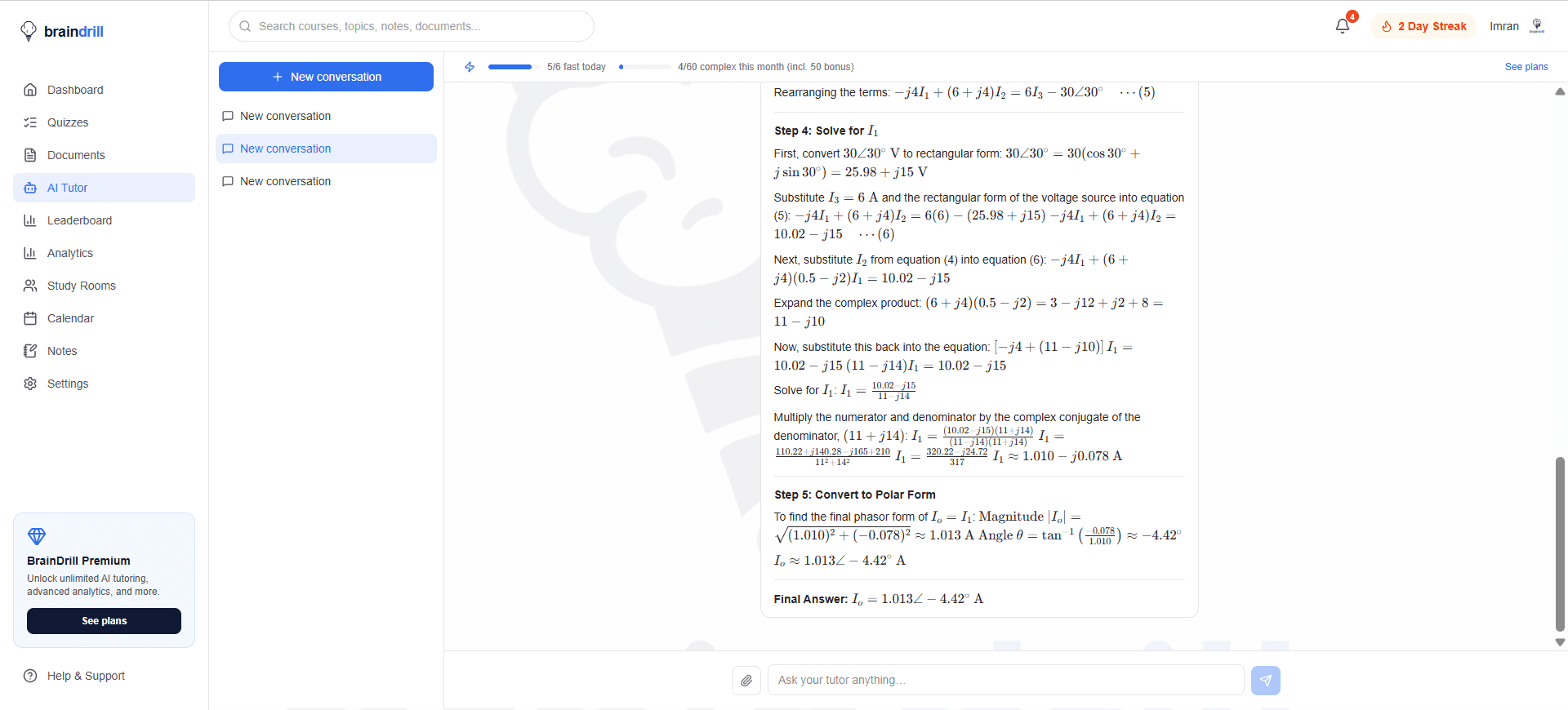
Imran Al-Ameen Adebayo
Engineering student and founder of BrainDrill — building the study app he wished he had. Read his story →
Study smarter, straight to your inbox 📬
One short email a week: a study technique that works, a topic worth drilling, and what's new in BrainDrill. Free, no spam, unsubscribe anytime.