The Best Way to Study as a Medical Student
By Imran Al-Ameen Adebayo · Founder of BrainDrill · 8 July 2026 · 6 min read

Medical school is not a difficulty problem so much as a volume problem: the material is not impossibly hard, there is just an overwhelming amount of it, arriving faster than you can comfortably absorb. Students who thrive are not superhuman — they use methods that fit the volume. Here is what actually works.
Active recall beats rereading — especially at this volume
Rereading lecture slides is the default, and it is one of the least efficient ways to learn. Retrieval — forcing yourself to recall an answer from memory — builds far stronger, more durable memory. Turn each lecture's notes into a quiz and answer from memory the same day. The struggle to recall is the learning, and it scales to the mountain of content medicine throws at you.
Spaced repetition keeps it from leaking away
You will forget most of what you learn unless you revisit it at increasing intervals. Spaced repetition schedules those reviews so you meet each fact again just before you would forget it — the most time-efficient way to hold a huge body of knowledge. Play your quizzes as spaced flashcards so revision fits around clinicals and lectures.
Anatomy: understand relationships, then drill
Anatomy rewards understanding spatial relationships and then testing them relentlessly. Learn how structures connect and what they relate to, then quiz yourself on origins, insertions, innervations and clinical relevance. When a concept refuses to click, get it explained step by step rather than staring at it.
Physiology and pathology: learn the mechanism, not the fact
The details in physiology and pathology are far easier to hold when you understand the underlying mechanism — the cause-and-effect chain. Ask an AI tutor to explain the mechanism behind a fact, then test whether you can reproduce that reasoning yourself. Understanding one mechanism often unlocks a dozen memorised facts.
Snap the confusing concepts
When a diagram, pathway or calculation defeats you, photograph it and have the tutor walk through it. Then reproduce it from a blank page. That reproduction is what converts passive exposure into something you can use on a ward round or in an exam.
A sustainable weekly system
- Same day: turn each lecture into a quiz and take it once, from memory.
- Ongoing: let spaced repetition resurface older material automatically.
- Weak points: keep an error log; re-attempt it every week.
- Together: revise in a study room with coursemates — quiz each other and share the load.
Work with the volume, not against it
You cannot out-read medicine, but you can out-system it. Active recall, spaced repetition, and understanding mechanisms turn an impossible volume into a manageable routine. BrainDrill turns your notes into quizzes and flashcards, explains any concept step by step, and lets you study live with coursemates — free to start.
Put this into practice with BrainDrill
An AI tutor that shows its work step by step, quizzes generated from your own notes, and live study rooms with friends. Free to start — no card needed.
Try BrainDrill free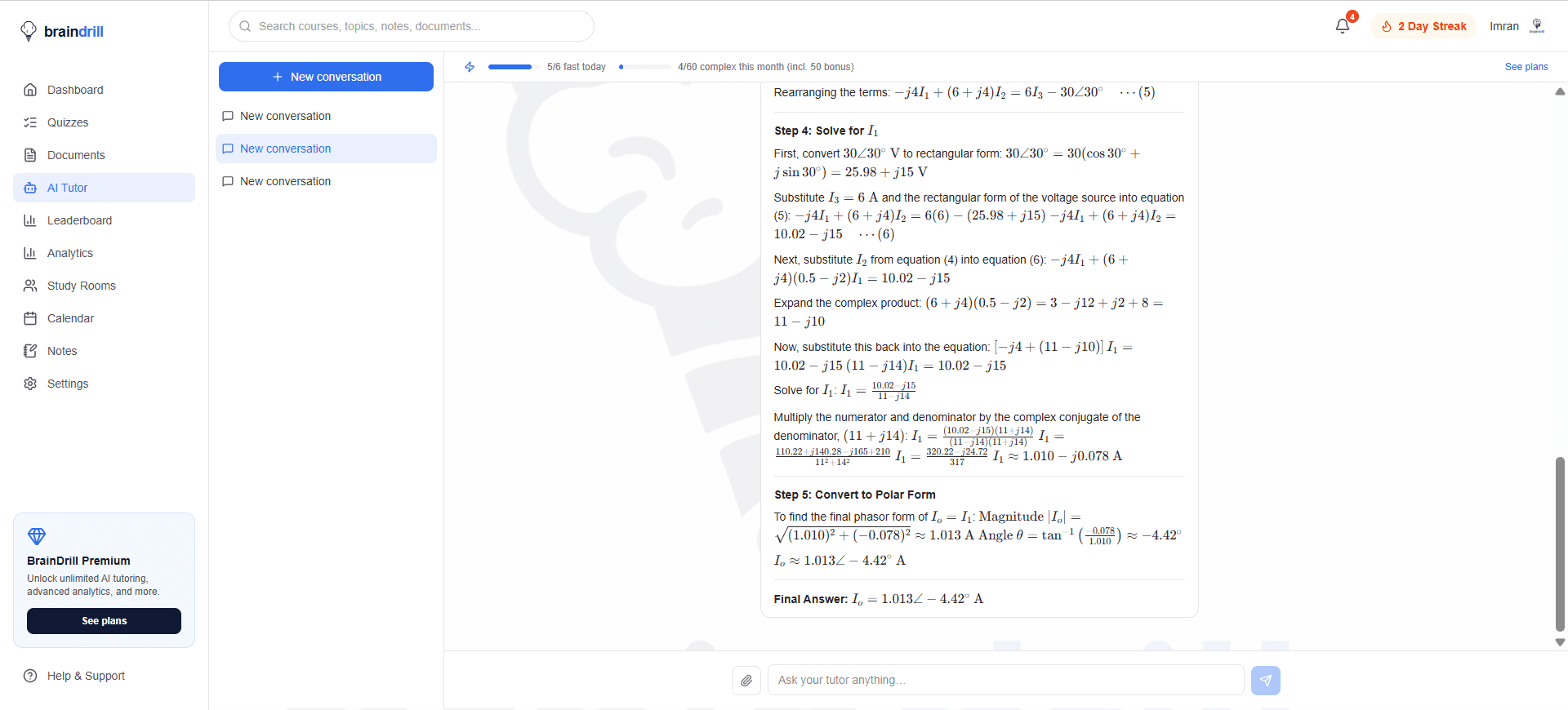
Imran Al-Ameen Adebayo
Engineering student and founder of BrainDrill — building the study app he wished he had. Read his story →
Study smarter, straight to your inbox 📬
One short email a week: a study technique that works, a topic worth drilling, and what's new in BrainDrill. Free, no spam, unsubscribe anytime.