
Looking for an App That Helps You Study? Here's What Actually Matters
By Imran Al-Ameen Adebayo · Founder of BrainDrill · 3 July 2026 · 5 min read

Type “app that helps you study” into any store and you'll get five different species wearing the same label: flashcard apps, focus timers, note apps, planner apps, and AI chatbots. Each does one slice. The question worth asking before installing anything: which parts of studying do you actually need help with? There are only four.
The four jobs of studying
- Understanding — getting unstuck when the textbook stops making sense. The app test: does it explain step by step, with reasons, and let you ask follow-ups? A tool that hands you answers without method fails this job even while appearing to do it.
- Practice — the job students skip and exams punish. Decades of research says retrieval (testing yourself) beats rereading by a wide margin. The app test: can it turn your own notes and past questions into quizzes — including written theory questions, not just multiple choice — and grade your attempts?
- Organisation — notes you can find and a plan you follow. The app test: notes that survive bad network, and a calendar that reminds youinstead of waiting to be remembered.
- Motivation — the quiet reason most study plans die. The app test: does it make progress visible (streaks, XP, standing among coursemates) and studying with friends possible, or is it a lonely grind?
Why five apps usually beat you (and one might not)
You can assemble the four jobs from separate apps — a chatbot, a flashcard app, a note app, a planner, a group call. In practice the seams kill it: your notes live in one app, quizzes can't see them, the planner doesn't know your exam dates, and every app is another download, another login, another background drain on a limited data bundle. Consolidation isn't a luxury feature; on a mid-range phone with metered data, it's the difference between a system you run and a folder of icons you feel guilty about.
A checklist to judge any study app
- Explains problems step by step and survives “why?” — including from a photo of the problem.
- Generates practice from YOUR materials, with theory answers graded, not just MCQs.
- Notes work offline and sync when data returns.
- Calendar sends reminders (a plan that relies on your memory isn't a plan).
- Progress is visible; studying with friends is built in, not bolted on.
- Installs from the browser, runs light on data and mid-range phones.
- Has a free tier that's genuinely usable, priced in your currency beyond it.
The disclosure
This checklist is BrainDrill's blueprint — we built it as one app covering all four jobs: an AI tutor that teaches step by step and verifies its answers, quizzes generated from your own notes and past questions with graded theory answers, offline-capable notes (typed or handwritten with a stylus), a calendar with push reminders, XP, streaks and leaderboards against your school, and live study rooms with screen share and a shared timer. Free plan first, so the checklist above can be tested against it with no card. But the checklist stands on its own — whatever app you choose, make it pass.
Put this into practice with BrainDrill
An AI tutor that shows its work step by step, quizzes generated from your own notes, and live study rooms with friends. Free to start — no card needed.
Try BrainDrill free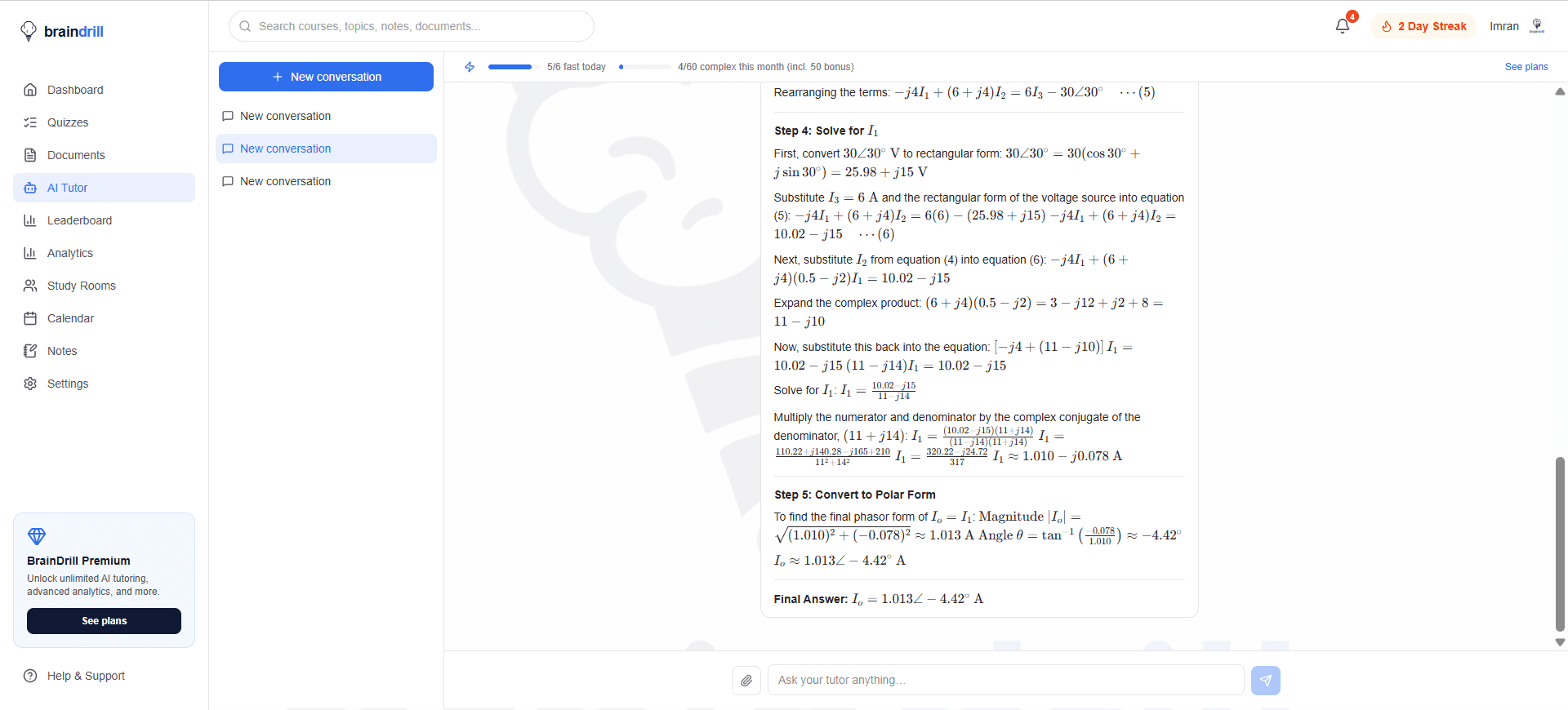
Imran Al-Ameen Adebayo
Engineering student and founder of BrainDrill — building the study app he wished he had. Read his story →
Study smarter, straight to your inbox 📬
One short email a week: a study technique that works, a topic worth drilling, and what's new in BrainDrill. Free, no spam, unsubscribe anytime.