
AI Homework Helper: How to Pick One That Actually Teaches You
By Imran Al-Ameen Adebayo · Founder of BrainDrill · 3 July 2026 · 5 min read

Search “AI homework helper” and you'll drown in tools that all demo the same trick: paste a question, receive an answer. But you don't actually need answers — your lecturer already has those. You need to be able to produce answers yourself, in an exam hall, with no AI in your pocket. So judge a homework helper by one standard: after using it, are you better at the subject?
Six things to demand
- Steps with reasons, not just steps.A solution that names its moves (“apply Kirchhoff's voltage law around the left loop”) teaches; an unexplained chain of algebra just relocates the mystery.
- It reads your actual homework. Retyping a circuit diagram or a three-line equation into a chat box invites transcription errors. A good helper reads a photo of the problem — handwriting included.
- It verifies before it answers. AI models can be confidently wrong, and a wrong answer you trusted is worse than no helper at all. Prefer tools that check their result — re-deriving it independently or substituting it back — before showing it.
- It survives “why?” Ask why that method, why not the alternative, what changes if a value doubles. An answer machine repeats itself; a teacher goes deeper.
- It can test you afterwards. The proof of learning is retrieval. A helper that turns your notes and past questions into fresh practice — and grades your written attempts — closes the loop that copying never will.
- It fits a student's phone and pocket.Light on data, works on a mid-range Android, priced for students, usable free tier. A brilliant tool you can't afford to run isn't your tool.
Red flags
- “Instant answers!” as the headline promise. That's marketing aimed at the copy-paste impulse, and the product usually matches.
- Final answers with collapsed or missing working. If the steps are an afterthought, learning was an afterthought.
- No way to practise. Answer-only tools leave you exactly as examinable as they found you.
- Confidence with no verification. If it's never visibly unsure and never checks itself, be suspicious of everything it says.
The usage rule that matters more than the tool
Even the best helper can be used badly. The rule that keeps homework help on the learning side: attempt first, ask second, reproduce third. Give the problem ten honest minutes, get the stuck step explained, then close the tool and re-solve from a blank page. And submit only work you produced — using AI to understand the concept is studying; submitting its output as yours is a policy violation at most universities and a debt your exam will collect.
Where BrainDrill stands
We built BrainDrill against exactly this checklist, so the honest disclosure is that this article describes our own design goals: an AI tutor that solves step by step with every step explained, reads photographed problems (with a QR handoff from phone to laptop), verifies its answers before showing them, answers “why” patiently in your language, and then generates quizzes from your own notes — including written theory questions it grades against marking points. There's a free plan precisely so you can hold it to the six demands above before paying anything.
Put this into practice with BrainDrill
An AI tutor that shows its work step by step, quizzes generated from your own notes, and live study rooms with friends. Free to start — no card needed.
Try BrainDrill free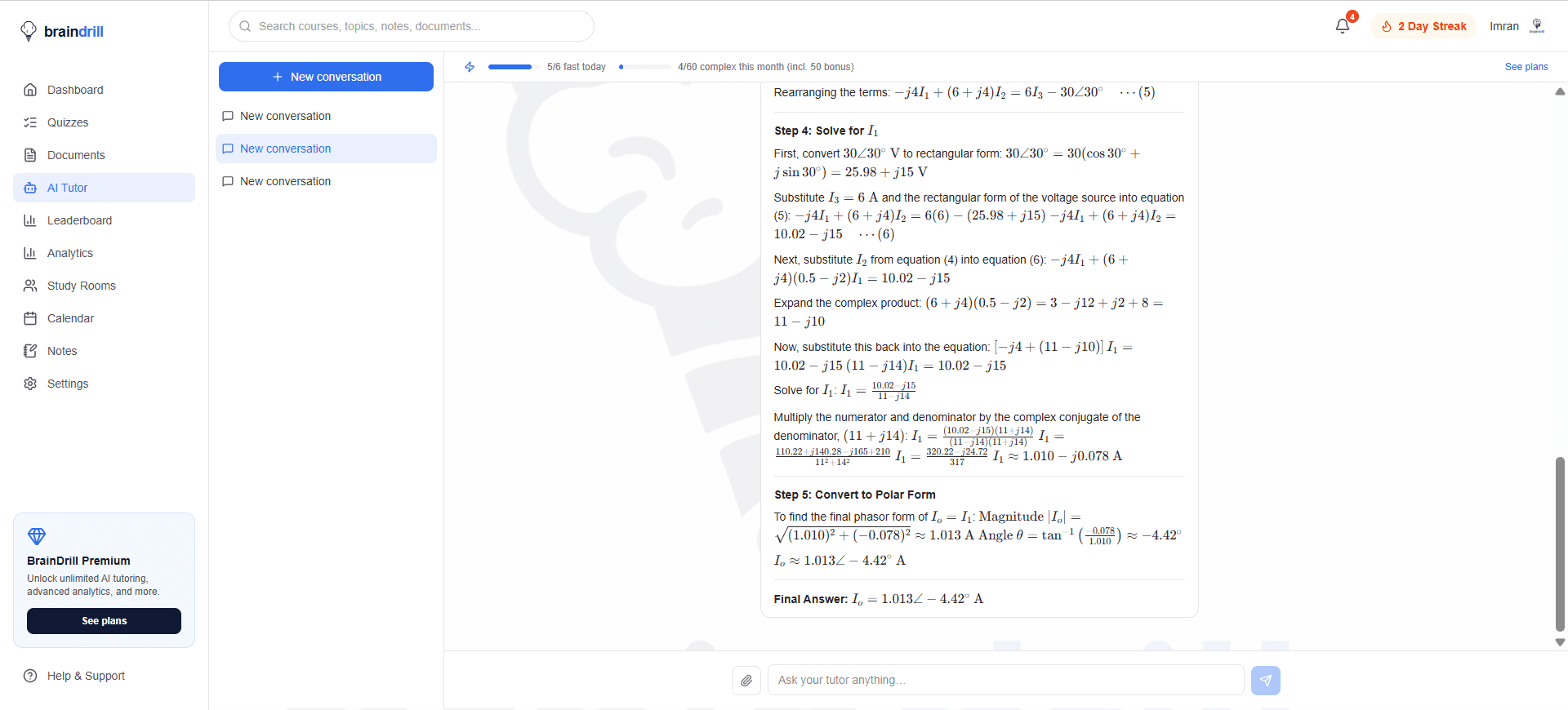
Imran Al-Ameen Adebayo
Engineering student and founder of BrainDrill — building the study app he wished he had. Read his story →
Study smarter, straight to your inbox 📬
One short email a week: a study technique that works, a topic worth drilling, and what's new in BrainDrill. Free, no spam, unsubscribe anytime.